Author Archives
The September Issue
Fashion is evil. But I’m a very bad girl, so I went to see The September Issue and just wasted 90 minutes of my life. This documentary, about the making of the 2007 edition of the American Vogue’s annual big issue, gives no insight into the magazine’s real workings, offering instead a few personality sketches, ranging form the ludicrous to the tragic. Everyone working on the magazine is about 76 years old but looks only 67 because most of their facial muscles don’t work, the effect, I presume, of botox. The vapid comments wafting from their rigid lips are, I presume, the result of what goes on in their heads – not much worth repeating, except maybe, “September is the Jhhhan-you-ary of fashion .” As parody it may be perfect but as a documentary, the movie was boring. If I had watched it at home, I would have fallen asleep.
I came away in disgust. Off came my tailored, fully-lined, flocked-denim jacket and the check, pale neutral-grey, fine wool pencil skirt with a high waist band and back slit. On went the ancient mens trackie dacks and ugh boots. If I was going to get to work on this post, I needed to tog out in some proper working clothes. Life is an endless costume opportunity and I have always loved to dress up. Only in the grips of serious illness do I not wear earrings for a whole day. Appropriate dress has always been the hallmark of my sartorial style. When working on property refurbishment/maintenance, I am mistaken for a cleaning woman. When I entered the Parkes Elvis Festival Priscilla Contest in 2005, I won. American Vogue is the only recreational magazine I ever buy, although never more than twice a year – September and December are the bumper months. Last year, I oohed over September’s 796 pages of divine looks; this year, the same month’s 584 pages were too dull to warrant more than a quick flick-through at Balaclava News Agency.
Americans are the richest people on earth and most of the other richest people of this earth also shop in America. The US Vogue can feature the most glamorous, outrageously expensive things without batting a tinted eyelash. Forget Tiffany, a loyalVogue advertiser, when you can buy “statement” acrylic (yes, real plastic) jewellery costing thousands of $US, as featured in the December issue in 2007. The model wears a cocktail dress and several of these big “jewels” around her neck and wrists but she is also wearing rubber gloves and is on her hands and knees swishing a scrubbing brush around a sudsy floor, in broad daylight. Never has housework been more glamorous. It just makes you want to put on your most fabulous evening gear and start spring cleaning the house, top to bottom. Or, it makes you laugh at the ridiculous fantasy. The models are gorgeous and the magazine is very careful to feature many very affordable items but the truth behind it is very ugly and The September Issue really points to that. The 2007 effort was a bumper 840 pages and had a print run in excess of 13 million copies.
Given that the real work of any commercial enterprise is to sell, be it your new novel or my nephew’s new Go-Green Computers business, we do need to ask what it is that we are being sold. Vogue’s business is to sell us a magazine that in turn sells clothing fashion but it is not as simple as it sounds because Vogue itself is a critical cog in the insidious process of manipulating fashion consumption. The September Issue says nothing about what Vogue really is or what it is doing, aside from acknowledging that editor Anna Wintour is the most important single person in the global fashion industry.
Any suggestion that this film will have one intelligent thing to say about the fashion industry is quashed at the very opening with some twaddle from editor Anna Wintour trying to dismiss negative criticism of dress fashion by saying that fashion makes people feel insecure because they are not part of the “in group”. In other words, people who don’t drool over fashion are misfits and failures. We are quickly filled in on Wintour’s true stature in the fashion industry as she is shown in one fur-trimmed garment after another and we are told how she single-handedly resurrected the fur industry by putting it on the 1992 September cover. The gloating over this proud achievement really stroked my “real people wear fake fur” pelt backwards.
Aside from all the furry trims, Wintour always wears only boxy, short jackets or short cardigans, printed, waisted dresses with high necklines and mostly with very full skirts. She favours a full boot or a sling-back shoe with a low to medium heel. A short string of chunky beads is colour varied to go with the different outfits. She doesn’t like black but the film doesn’t explain that in many colour circles, black is not regarded as a colour. Stylistically, Wintour has only one look and it depends entirely on her scrawny form. Stalking about with her snub features and reptilian skin, she resembles an emaciated dinosaur looking for a kill. She spends a lot of her time with her arms folded, glowering her displeasure at everyone and everything. The publisher acknowledges that she is a cold person. What he doesn’t add is how warmed he and his cronies are by the rewards they reap through her arrogance and hired- assassin efficacy.
Wintour is said to have been the inspiration for Miranda Priestly, the fashion editor inThe Devil Wears Prada, which was written by her former personal assistant, Lauren Weisberger and made into a movie starring Meryl Streep. While autocratic disregard for others and bullying is a shared characteristic, Wintour, as seen in The September Issue, has none of the colour and brittle verve of Streep’s creation.
When the camera is not on Wintour, it focuses on creative director, Grace Coddington, who brings 45-years of fashion savvy to the magazine’s photoshoots and themed spreads. It is her task to sate the finicky Wintour’s desire for the ineffable. Coddington , with her crinkly red mane, imposing height, choice of black, knee-length sack dresses and comfort sandals is exactly what you would expect from someone in her job. Youth, beauty, fantasy and luxury can only be sold by the ugly reality of harrowing hard work by seasoned veterans. Coddington is also able to distinguish between “perfect models” and “real” people. Looking at the spreads that Coddington prepares, you can see her mark on Vogue signature looks: airborne kinetics, faded-pastel fairytale fantasies, opulent old-masters artifice and whacky juxtapositions.
Aside from Wintour’s passing acknowledgement of Coddington’s “genius”, there is not much dignity for anyone at Vogue. We never see the fleets of personnel involved in every aspect of producing the issue. The film also doesn’t explain the first thing about how this major publication is put together and what human and technical resources are harnessed in the production. There is no truth here and definitely no glimpse of Wintour’s three personal assistants although we do catch sight of the hired domestic help, a black woman, at Wintour’s New York townhouse.
The only time The September Issue reaches a level of mild psychological interest is when we are presented with Wintour’s young adult daughter, who thinks she’d like to do some serious work, perhaps in law; and when Wintour reveals that her siblings have a low-regard for her work. It is not surprising that they should feel this, given that, according to her, one brother is working in community housing, another as a political editor and a sister is helping farmers in South America. Wintour’s condescending description of their jobs seriously understates the level of their professional ranking.
Ironically, I had intended to see Coco Avant Chanel but decided against it on philosophical grounds. As the film’s title means Coco, Before Chanel, it amused me to come across warnings that it only deals with Chanel’s early life, not because I expect people to understand French but because I would think that you would bother to find out what a film’s title means if you were going to see it. While it seems obvious to me that the most interesting aspect of Chanel’s story would be in how she got started, on reflection and a bit of reading, I was reminded of Chanel’s close association with Nazis during the second World War. Problematic material, to say the least, and for me as off-putting as Wintour’s support for the bloody fur industry and the taking of life for pleasure. It is a case of ugly,ugly, ugly, inside and out.
Blazenka Brysha 17/9/2009
The Real September Issue
After writing the above, the newshound in me just kept digging up the dirt on Anna Wintour, of which there is a landfill quantity on the net. It came as no surprise, given that her trade is the press and that her Jimmy Choos have reportedly trod on many a face en route to power, money and fame. Live by the press and die by the press. In fact, had I known anything more about Wintour than her reputation as a draconian power-wielder, I would have realised that no genuine documentary crew could get within 50 meters of her.
It is said that Wintour allowed the documentary in order to raise her profile and perhaps it worked. After seeing The September Issue, my mother-in-law commented that Wintour was not as hard as she had expected, so, clearly my mother-in-law knew more about Wintour than I did at the time. My friend Vicki Steer admitted to seeing the film and observed that she found Wintour’s power “mystifying”. But what Wintour is like as a person – and I came away from The September Issue with the impression of chilling ruthlessness – is not necessarily directly related to her ability as a marketer of fashion, which is what she is ultimately.
The secret of her power/success is graphically exposed, indeed splashed across the pages of the 2009 September issue of US Vogue. If you count the covers, both sides, it has 588 pages, of which 388 are bought advertising. There is much other product promotion, complete with price tags and where you can buy it, in the editorial pages, including 5 pages called Index that feature masses of products under $US500. There’s even a Kmart cashback offer in an advertorial. Most, but not all the promoted products are from brands advertised in the magazine.
The essence of Wintour is her ability to get advertising money out of Valentino and Kmart, Blahnik and Payless Shoes, Target and Nordstrom, Chanel and Covergirl. Of the 388 pages of ads, 103 are for mass market consumer goods – including the 8 pages from UGG Australia – costing relatively little as units but generating billions for the fashion/beauty industry. The 103 pages do not even include Rolex or Tiffany, staple brands of middle class must-haves. Nor do they include any of the stuff I didn’t automatically recognise as available everywhere, so there would be a percentage in that, too.
The first story in the magazine is on page 278 and it’s about and written by a self-made woman film producer, who had to reinvent herself at the age of 21 when her father lost his $US50m stockmarket fortune in 1997. I am reminded of the bit in My Brother Jack when David, having listened to whinings about the hardships of being the younger son of a British lord, makes the point that it’s tougher being the younger son of a Melbourne tram driver.
After 382 pages of ads, you arrive at the guts of the magazine. First comes Grace Coddington’s Into the Woods, a 13-page spread with a Red Riding Hood theme. Then there are 10 pages on the cover celebrity, Charlize Theron, 4 pages on the paintings of Georgia O’Keeffe, a 10 page spread on coats and 16 pages of 1940s looks. Philharmonic conductor Gustavo Dudamel gets 4 pages before we get back to business with 4 pages on Fashion’s Night Out, a global shopping event promoted by Vogue International and spearheaded by the US edition. Retailers put on special events for one day, featuring fashion celebrities appearing at stores like Bloomingdales (Target for the rich). This is important because, “If we don’t shop, people lose their jobs.” That would be especially terrible for Anna because where would she be without her work?
Then come 4 pages on Roger Federer, on whom Anna is said to have a “crush”. Indeed, in her editorial she declares, “Roger Federer is now established as the greatest tennis player of all time.” I do not follow tennis, so I don’t know how true this is but there is ample indication that Federer is Wintour’s pet human. While on the home front, this is followed by 8 pages on British fashion tycoon Gela Nash-Taylor, showing all the splendour of her Tudor manor. Then 4 pages on Jenny Sanford, about whom I learned all I need to know from my colleague Adair Jones in her piece at
After all that you might need a drink so there are 4 pages explaining why bars are more hip than restaurants and which bars are it in New York (just in case you go). Apparently, “a proper bar has hooks in front of each stool” for your handbag. Hot places lead to hot people, so we get 2 pages on Hugh Jackman, then 2 on supermodel Karli Kloss, followed by 18 pages of fashion to keep you warm if not hot: gloves, boots, suits etc.
If you overlook that every fashion item featured in this editorial section is being plugged, there are no ads at all. This is quickly corrected by the above-mentioned Index spread and a few more ad pages, bringing the issue to a thumping close. And that is the real September issue, which is how Vogue was promoting it.
In it there is even an ad for the movie, and in her editorial, Wintour confides, “It is difficult to speak about a film that scrutinises one self but at Vogue, we were happy with the result.” She may speak like the Queen and she may not be able to “write” – having left school at 16 – but she sure knows her business and when she was photographed queuing to see the film, it wasn’t because she couldn’t see it any other way. She was keeping her nose to the ground and doing some first hand market research, because she is a marketer and that is what she is paid a said $US2m plus a year to do.
ENDS 25/09/09
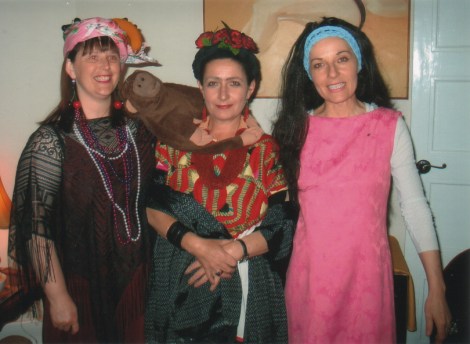
- FABULOUS FASHIONISTAS The Brysha sisters seen at Tijuana Party, l-r Marta, as Carmen Miranda, Mihaela as Frida Kahlo, sporting monobrow and monkey and Blazenka, in her award-winning Priscilla Presley costume. (Detailing: dodgy childrens wig-Toyworld, Werribee; damask cotton shift – McCalls pattern, Lincraft fabric; headband – $2 shop, Balaclava; huge ring that swayed the judges – heirloom paste glass brooch on bandaid; spenser – old, not worn at Parkes.
Pride and Prejudice and Profit$
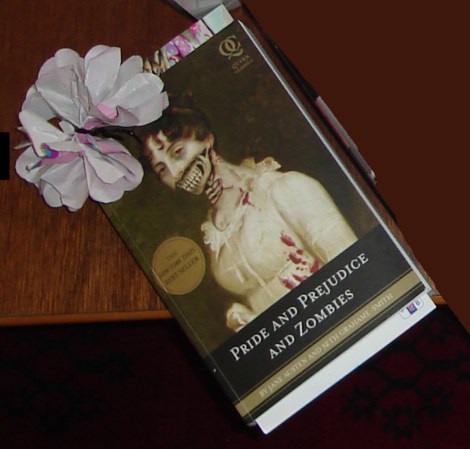
It is a truth universally acknowledged that a publisher in search of profits must be in want of a most marketable text. Indeed, if one were to maximise the margins, one could do no better than prey on a much-loved and globally recognised testament of the Western Canon.
And that is how Pride and Prejudice and Zombies by Jane Austen and Seth Grahame-Smith (Quirk Classics, 2009) came to be. At the suggestion of an editor, Grahame-Smith hacked his way through Austen’s most popular text, inserting zombie action into the storyline and rewriting Austen’s characters to deal with these new plot twists. Zombies are the living dead, the walking corpses that wander roboticly in search of the living, on whose brains they feed after cracking open their skulls. Zombiism is an infectious state transmitted through biting, as we learn when Charlotte Lucas confides in Elizabeth Bennet that she has been bitten by a zombie and therefore, as her days are numbered, she will marry Mr Collins because he can fulfil her modest expectations of the marital state and give her a proper beheading and Christian burial after her transformation into a zombie is complete. Charlotte’s descent into decomposing housewife oozing pus and talking in what sounds like Sambo-speak, awh mah lawd, it do make me laff.
In Grahame-Smith’s version of Austen’s England, the country is in the throes of a zombie plague and as zombies can only be dispatched by beheadings, their violent destruction is the responsibility of the military but citizens with a serious interest in survival also require deadly fighting skills because they might be needed as zombies are likely to gatecrash balls, eat the kitchen staff of a grand estate as they prepare to serve desert, which is ruined by the bloody splatter, and interrupt just about any genteel activity found in an Austen novel. So, Grahame-Smith’s Bennet sisters are Shaolin-trained warriors, Wickham, D’Arcy and Lady Catherine de Burgh are initiates of the Japanese fighting arts and the zombies are just freestyle cannibals, giving everyone ample opportunity for frequent, lethal encounters and buckets of yuckky viscera.
But I’m making the work sound a lot better than it reads. While blood, gore and guts, with a supernatural twist – staple fodder of late 20thC youth entertainment – have been added by the hospital biohazard skipful, Grahame-Smith does a poor job of marrying his contribution to Austen’s archaic, and by modern standards of informality, delightfully pompous language.
Clearly, the popularity enjoyed by Pride and Prejudice in recent years has more to do with its treatment on screen than Austen’s skill with language. Filmed versions of the book have abounded, most notably the BBC’s 1995 TV production with Colin Firth and Jennifer Ehle in the leads, capturing the essence of Austen’s opus in 6 easy episodes without anyone but writer Andrew Davies, an award-winning screen adaptor of classic novels, having to read a word of the novel. Nevertheless, Austen, as the teller of the story, is given full credit for her creation, which is, more or less, a love story for teenagers, featuring a number of mateable virgins and their suitors, an assortment of problematic relatives, and throbbing with unresolved sexual tension more volatile than an industrial accident in a pharmaceutical laboratory manufacturing hormones for the treatment of flagging libidos.
The virgins cover all types: sexy and sweet (Jane), sexy and sharp (Elizabeth), sexy, buxom and bawdy (Lydia), sexy and silly (Kitty), sexy and juvenile (Miss D’Arcy), sexless and intellectual (Mary), sexless and dowdy (Charlotte), sexless and sickly (Miss de Bourgh), and last but not least that great archetype, sexless and shrewish (Miss Bingley). Zip up your pants, boys! Speaking of which, the bachelors offer varying degrees of eligibility, covering the 19thC desirable job wishlist. Among them we have the landed gentry in D’Arcy, the fantastically rich, impossibly handsome and scandalously arrogant alpha male/bad boy, and his friend, Bingley, a beagle reincarnated as a good-natured, rich, upper class twit; the clergy in Mr Collins, a drivelling slimeball, next to whom it is agony to sit let alone contemplate physical contact with; and, of course, the military in Wickham, the mendacious reprobate slipping as easily into virgins’ confidence as into their vaginas, and Colonel Fitzwilliam, who is without any glaring faults apart from being “a younger son” whose consequent lack of fortune prevents him from marrying where he might like. But Austen does not spoil everyone’s fun by dwelling too long on anything remotely serious here; she saves that for Persuasion.
The relatives are as easily dispatched as zombies milling on a busy helicopter landing pad. Mrs Bennet who talks too much and thinks too little is a constant embarrassment to her children. Mr Bennet, who speaks in cutting sarcasms, spends all his time hiding in his library. Best of all is Lady Catherine de Burgh, the aunt from hell who proves that social status, riches and genetic pedigree are no guarantee of good breeding, personal quality and effectualness.
When you take a close look at Austen’s story and characters there are many ways to improve on it and Seth Grahame-Smith tries his best to fix it.
Aside from the poetic treatment of Charlotte and giving Lady Catherine a troupe of ninjas, Grahame-Smith disappoints.
His feeling for Asian martial arts is as fake as Charlotte Collins’s orgasms would have been. The Bennets are Shaolin (Temple in China) Chinese boxing followers so they would never set foot in dojos (Japanese karate training halls) except to vanquish a karate opponent (see – literally – Fist of Fury, 1972, Lo Wei). Elizabeth Bennet would never use a Katana – a Samurai sword – when she could use a dragon pole, which would give her better reach until she could get in with her butterfly swords, one for each hand, spun in continuous figure 8 motion, dismembering anything in reach. If Grahame-Smith tackled a religious subject he would have a Methodist minister say Mass in a mosque. A little bit of credibility, please.
The reworked novel’s conclusion is more horrifying than any zombie-wreaked havoc: “the sisters Bennet – servants of His Majesty, protectors of Hertfordshire, beholders of the secrets of Shaolin, and brides of death – were now, three of them, brides of man, their swords quieted by that only force more powerful than any warrior.” It’s not just the secrets of Shaolin about which Seth doesn’t have a clue.
But it is Grahame-Smith’s crime against language that is heinous beyond censure. It includes Mr Bennet referring to his wife as a “silly woman” and other lazy modernisms where period detailing of form and content may have been vastly more amusing and indeed the very palliative to make so odd a concoction as Mr Grahame-Smith’s endeavour bearable for those with highly-attuned cultural sensitivities. Worst of all, it features the mutilation of a pronoun, “…as for my sisters and I, our father thought it best that we give less of our time to books…”(p34). Here Seth is not alone and a plague of this is upon “us”, that’s “you and me”, babe, not YOU AND I! A plague is upon me and upon you but you will still be you whether you are the subject or the object, whereas I will be me when I am the object. Why do you do this to us, the other readers and me? On the back cover blurb of Pride and Prejudice and Zombies, it states, “Seth Grahame-Smith once took a class in English literature” so, he can consider this his class in English language.
Seth, all I can say is,”You have offended me, my (literary/literate)family and the Shaolin Temple.” Well done, old chap!
Blazenka Brysha took many classes in English literature and language, on both sides of the desk. She devours books with all the greedy, lip-smacking relish of a zombie cracking open a toddler’s soft skull and sucking out the warm brain, which is probably why her daughter gave her a copy of Pride and Prejudice and Zombies as a birthday gift.
Also published in The Group Online Magazine, Issue 5.
The Frutiger Story
I asked Emily to start a Frutiger fan club on Facebook.
“No, you start it,” she snapped back at me. Although she is 22, entirely self-supporting and living independently in the wilds of inner-Melbourne suburbia, I’m still her mother and the protocol for talking to parents is a bit like talking to pets, only it’s not sweet and it doesn’t involve silly voices.
“Pleeeease,” I begged. I may have admitted that I didn’t know how to. Golden rule of using computer technology is knowing when to reveal your ignorance. The young can be very cruel as you hobble from menu to menu trying to do things that you can’t because you don’t even realise that, for example, HTML might be set to off etc.
Emily was adamant.
“No,” she repeated, “Because then I’d be the administrator of this horrible club with you as the only member.”
As part of her degree course work, Emily has to reproduce print type faces, freehand. We were gathered outside her father’s house, when she showed him two samples of her work.
After a long career in journalism, specialising in high-end production, Campbell Smith (who refuses to come on Facebook!), has absorbed typefaces into his genetic profile. From the pre-computer days, when he wielded a scalpel and cut typeset galleys, which is how columns of print were once created, the one constant has been typography. It not only endures, it flourishes. Look at all the different fonts you get with various programs. I’m delighted by all the swish new fonts in NeoOffice, which I’ve just started using as a way of undermining the insidious greed of Microsoft, and also because the latest version of Word is so tricked up by zillions of nerdy functions that make it as clunky to use as a semi-trailer in a city lane.
So, Emily displays her work, showing a serif and a sans serif face. Clean, perfect black lettering in the equivalent of chocolate bar “fun size”. She asks her father to identify them. The sans serif is, of course, Helvetica.
“What, no Fruitger?” I demand. When I worked with Campbell in the 1990s, our favourite font was Frutiger for any small print. It is a handy, highly-legible small face but it was the name itself we liked to say. “Fruity-jer” was proposed at the drop of a hat.
Campbell ran into his house and came out with a big, thick hardback, flipped to the last pages and read a paragraph that celebrated Adrian Frutiger, the creator of the eponymous font, among others. As fact, this was quite thrilling.
I just had to have more detail, so I went to Wikipedia, the people’s resource and a good port of call when the facts you need have a comfy margin for softness. In this new Information Age, I’ve come to divide facts into two categories: hard and soft. Hard fact is indisputable – map co-ordinants, chemical formulas and anything you can 100% prove. Soft facts are more open to opinion. For example, Emily was only a child when, looking at a packet of small chocolate bars, she observed, “Fun Size…I think they should be Sad Size.” Sizing, unless given as numeric measurement, is always soft fact, as witnessed by the concept of small, medium and large, especially in clothing and food serving. Could the two be related?
But back to our hero, Adrian Frutiger.
Wikipedia states, “Frutiger’s goal was to create a sans serif typeface with the rationality and cleanliness of Univers, but with the organic and proportional aspects of Gill Sans…
Frutiger’s simple and legible, yet warm and casual character has made it popular today in advertising and small print.”
The font is popular in corporate use and in public transport (Oslo, Norway; Charles de Gaul Airport, for which it was designed in 1968).
You cannot imagine my disappointment to learn that “Frutiger” is pronounced with a hard “g” as in “go” and not a soft “g” as in “George”. But I did get this from Wikipedia so it might not be quite 100% correct…
To me, it will always “Fruity-jer”.
Blazenka Brysha 9/8/2009
 Blazenka Brysha