Dance Creation 2010 – Review

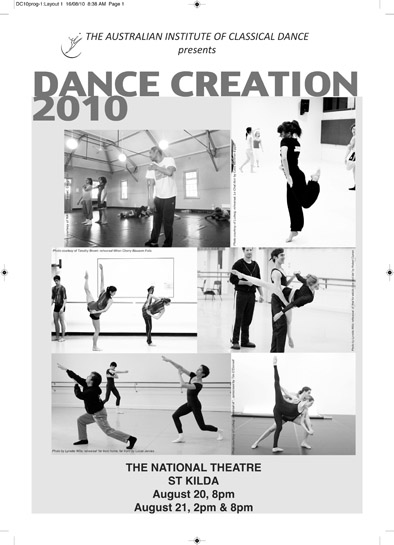
After the AICD’s Dance Creation 2010 opening night performance, the audience left the theatre smiling, talking and walking briskly. No doubt, the quality and variety of works and dance styles on show satisfied a wide range of tastes and certainly gave people something to talk about. No-one mentioned there was not a pointe shoe in sight but some noted that not all on offer was in the classical style.

The AICD’s Dance Creation 2010 took a long time to produce – fourteen years, in fact. That is how long this national, biennial choreographic showcase has been running and this year’s three-performance season was the culmination of the intentions and results of that first Dance Creation, held in 1996. Three of the six works in Dance Creation 2010 were by choreographers who got their start as winners of various awards made during the event’s original incarnation as a competition and the shift from pure classical style actually occurred at the very outset.

One of the great things about Dance Creation is the total artistic freedom given to the choreographers and this has really paid off. What a joy it has been to see the unfettered artistic evolution of a Timothy Brown, Lucas Jervies and Timothy O’Donnell.

Under the current format, participating choreographers are selected by AICD Victoria on the basis of nominations from the artistic directors of major Australian dance companies and institutions. Dance Creation 2010, held at The National Theatre, St Kilda, 20-21 August, featured new works by Timothy Brown (nominated by Natalie Weir, Artistic Director, Expressions Dance Company), Robert Curran (nominated by David McAllister AM, Artistic Director, The Australian Ballet) Deon Hastie (nominated by Leigh Warren, Artistic Director, Leigh Warren and Dancers) Lucas Jervies (nominated by Marilyn Rowe OBE, Director, The Australian Ballet School) Timothy O’Donnell (nominated by Ivan Cavallari, Artistic Director, West Australian Ballet) and Ludwig (nominated by Ivan Cavallari, Artistic Director, West Australian Ballet).

The works were performed by dancers from The Australian Ballet, The Australian Ballet School, NAISDA College of Dance, QUT Faculty of Creative Arts (Dance) and Ludwig, the recently-formed, Perth-based ensemble, whose work embraces performance, choreography, photography and film.

The program opened with Timothy Brown’s When Cherry Blossom Falls, set to Ludovico Einaudi’s Divenire spliced with nature sounds, the latter unacknowledged in the printed program and presumably the choreographer’s own addition. Using an ensemble of one male and six female QUT dancers, Brown matched the lushness of Einaudi’s piano score by a continuous flow of movement of a low muscle-tension, contemporary style. Bodies fell to the floor and tumbled, rising individually and grouping into sculptural formations, giving the work shifting perspectives from above and below. Despite all the floor work, the overall impression was one of lightness. The random geometry of the ensemble work, presented with such naturalness and simplicity, imbued the piece with lyrical feeling. This is definitely a work that would suit a range of dance bodies and styles of interpretation and, as such, would sit very nicely on a company that prides itself on versatility.

We didn’t get too long to reflect on the evanescence of blossom before Timothy O’Donnell hijacked the audience with Trust Me on the Sunscreen, in which he also performed, with his partners in art, Emma Sandall and Cass Mortimer Eipper. The trio are Ludwig. The work, set to Baz Lurhmann’s monologue Everybody’s Free (To Wear Sunscreen, is a witty, energetic romp in classical style, revved up to underline the rousingly positive advice on offer, which includes statements such as: “You are not as fat as you imagine…” This got a big laugh of recognition from the audience, most of whom were young dancers. The expansiveness of the choreography is given a punchy delivery by the dancing, which gets a big leg-up – literally – from Emma Sandall’s virtuosity. She is a stunningly extended dancer who understands sensitive articulation, which should be the aim of any classical dancer who wants to take a move all the way but not cross into acrobatics.

Deon Hastie’s Caught is “an exploration into the power of mussing, an aboriginal technique that involves capturing someone’s affection by using a special root of a tree and rubbing it into the skin.” It was performed by dancers from NAISDA and used a contemporary style, combining 20th C non-classical with more recent influences of street styles and some indigenous moves. This was Hastie’s – and NAISDA’s – first Dance Creation and what a revelation it was. At the risk of sacrilege, if you needed an antidote to classical overdose, this was it. The ensemble of three men and four women threaded their way through the intricacies of physical encounters while the bassy, infectious beat of the electro score, (from Book Shade’s Movements) made for an appropriately thematic hypnotic effect. The spell-mixing motif, of one hand cupped and the other stirring around in it, repeated by the men, was especially memorable and one good, original move is worth dozens that you’ve seen before. Deon Hastie is definitely a choreographer to watch and Caught, along with When Cherry Blossom Falls, is the work I would most like to see again.

Cass Mortimer Eipper, representing Ludwig’s nomination, showed an excerpt from Le Chat Noir, a larger work that he is creating on Link Dance Company, the graduate company based at WAAPA. This was a rhythmic, fun piece featuring five women and relying on isolated body part moves for its effect. Set to the infectious beats of Der Ditter Raum’s Swing Bop and the Benny Goodman standard Benny Rides Again, on this occasion by Big Band Remixed and Reinvented, it evoked the atmosphere of a cabaret, a suggestion also offered by the work’s name, which harks back to the legendary venue of late 19th C Paris. It was difficult to gauge whether the excerpt was an isolated piece of whimsey or something more substantial in the context of the work as a whole. Nevertheless, it was performed with verve and charm and indicated that Ludwig can produce more than one type of choreography. Between that and the company’s ability to deliver gob-smackingly good dance, they should go a long way, if they can stay highly productive and keep clutching any lifelines they can grasp in the daily battle for survival faced by any genuinely artistic venture. The company’s website is light on disclosure of the business end of things, merely acknowledging a few private companies as ‘supporters’, which indicates that it receives no funding.

Robert Curran’s that for which I live and die is a duet for his fellow members of The Australian Ballet, Brett Chynoweth and Sarah Thompson. Set to Eugene Ughetti’s Intermezzo and James Newton Howard’s Snow Falling on Cedars, it was described by the choreographer as “an abstract exploration of existentialism, based on the writings of Soren Kierkegaard and focuses on one man’s experience/understanding/struggle with the meaning of his existence at an unspecified time in his life.” That’s a lot to tackle in the ten or so minutes of the work’s running time. What Curran does offer is a hardcore classical ballet duet fragmented into solos for both dancers, allowing them to interact at certain moments. A highlight of inventiveness has the man handling the woman by her hip, with one body slipping around the other in an agonised relationship of connecting awkwardly, which is contrasted with incidents of paralysing isolation. Chynoweth and Thompson made their own contribution to the work with their stellar performance of it. Whether the depth of choreographic talent evidenced here goes anywhere, is entirely up to Curran and depends on how productive he can be, which is the knife edge for any creative artist.

The most sophisticated work on the program was Lucas Jervies’ from home far from, using an ensemble of 14 dancers from The Australian Ballet School. Although we should never judge a choreographer by the size of his ensemble, the ability to manoeuvre and manipulate numbers of bodies is a core skill that any aspiring choreographer needs to develop because any repertory or commissioning dance company is likely to have ten or more dancers. Jervies shores up his efforts by enlisting the muscle of Beethoven as back-up, using Piano Sonata #32 (youtube offers a magnificent selection of renditions, including from Barenboim, Arrau and Richter) as his score. The piece is part homage, part thank you to Balanchine, Beethoven, Bournonville, Bob Fosse, Marco Goecke, Michael Jackson, Stephen Page and Georg Reischl for their inspiration to Jervies.

The word homage implies reference but in Jervies’ case the influences are so filtered through his own interpretative vision that the only overt link I detected was to Goecke in some of the arm movements. This is only fleeting, as Jervies focuses on a combination of hand gestures and flagrant shoulder rotations, often with only slight body turns and minimal simultaneous movement of feet. Except for the fact that everything springs from classical technique, it looks like the biggest influence comes from the use of shoulder joints in street styles like hip hop. But the dancers don’t just wear out their shoulders and flap their hands. They are also challenged to move as an ensemble that morphs numerically into patterns and combinations that keep the piece moving satisfyingly. Jervies is a 21st C ballet choreographer, which is exactly what the artform desperately needs now because if it is not constantly renewing itself with new works and new challenges, it runs the risk of what befell the dinosaurs. For the last 20 years ballet has been dominated by “kerpow” athleticism and astonishing physical feats but little meaningful content and feeling. It’s time to turn the tables and a Lucas Jervies should be a number 1 recruit to the cause. As one of the adjudicators of the 1996 Dance Creation panel that awarded him the Edouard Borovansky Award for Student Choreographers, I am particularly pleased to see the show of promise pay off because more often than not, dance is as ephemeral as cherry blossom, so well observed by Timothy Brown.

It is to be hoped that all the participating choreographers will be proactive in mounting at least excerpts of their Dance Creation 2010 vids on youtube – the dance artist’s new best friend. For one thing, all the performers could be tagged and given some ongoing credit for their wonderful contributions. Cultivating a presence, sharing your work, exchanging with other creative people and exposing yourself to new influences can only improve your art. Worry about “giving it away” and intellectual property rights are not an issue if you use the quotation approach. Furthermore, as everything on the web is dated, you have proof of primacy of origin. It’s time to get feral. Art has no business being safe.

Dance Creation relies exclusively on sponsorship: some corporate, a lot from a few private sources and a huge amount in kind from the many interested parties, especially the AICD and the dance institutions, both company and educational that provide the material, the infrastructure and the enthusiasm to make Dance Creation happen. The unsung hero of this glorious quest is Dame Margaret Scott AC DBE, Founding Director of The Australian Ballet School and one of the major figures of Australian dance history. Her vision and tenacity have enabled the practical survival of this on-going venture. It was Dame Margaret who rescued Dance Creation from imploding as a competition by steering it towards its current format.

Dance Creation survives on a wing and a prayer and the boundless generosity and naïve optimism of a disparate cross-section of the dance community and their efforts to do the little bit they can by inspiring, begging and nudging others into doing as much. There is an old saying that when you can do very little, the worst thing you can do is nothing. Well, that’s one thing of which you cannot accuse this mob.

Blazenka Brysha

24/08/2010

Footnote: The Australian Institute of Classical Dance was formed in 1991 by Marilyn Jones OBE following her receipt of a Creative Artists Fellowship from the Australian Government.
The Institute is a non-profit organisation with a board composed of eminent members of the dance profession. It was set up to oversee and encourage the development of Australian classical ballet.
Marilyn Jones, a celebrated 20th C ballerina, is the Artistic Director of the AICD. Garth Welch AM is Chair of the National Committee and Steven Heathcote AM is the national patron.

Dance Creation is steered by an Executive Committee, whose membership is: Dame Margaret Scott AC, DBE (Chair), Annie Denton, Charles Heathcote, Colin Peasley OAM, and Jill Rivers.
David McAllister, Artistic Director of The Australian Ballet, is patron of Dance Creation.

Dance Creation 2010 Donors and Sponsors
Dame Elisabeth Murdoch AC DBE
Mrs Elizabeth Albert and Mr Robert Albert AO RFD RD
The Tania Liedtke Foundation
Mr Glen Robertson
Miss Jean Stewart
Professor John Rose and Mrs Rose
The National Theatre
Ms Ann Ryan
AICD National Council
AICD Western Australia

Dance Creation 2010 also gratefully acknowledged the assistance received from
The Australian Ballet
The Australian Ballet Society
Dance Australia Magazine
Easy Stay, St Kilda
Margaret Mercer
Seagull Press, Belgrave


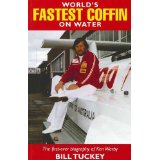
World’s Fastest Coffin On Water

Review
World’s Fastest Coffin on Water – the first-ever biography of Ken Warby
Bill Tuckey (Bas Publishing, 2009)

Unless you are a follower of sporting achievement statistics, you have probably never heard of Ken Warby. That’s even if you were around in Australia on November 20, 1977, when Warby set the world water speed record, which he then increased in 1978 and still holds, in a home-made boat, at Blowering Dam, NSW.

World’s Fastest Coffin on Water – the first-ever biography of Ken Warby (Bas Publishing, 2009) has all the ingredients of a riveting, multi-faceted read, encompassing an eccentric chapter of Australian sporting history, and author Bill Tuckey, himself a legend of Australian motoring journalism, makes the most it.

The Warby story is told in two strands. One focuses on his personal history: his working-class background, his family life in industrial Newcastle, NSW, in the mid-20th century and the forces that shaped him, socially and psychologically. The other strand tables his phenomenal sporting achievement and what that entails, including the historical, statistical and mechanical background against which Warby’s story played out. The result is a fascinating mix of social history with lashings of Australiana, psychological exposition and everything anyone could ever want to know about water speed records and what it takes, in terms of human and mechanical resources, to break them. It is also a quintessentially Australian story about a battler obsessed by an idea and maniacally fixed on fulfilling his goal. The story is comic and tragic in equal parts: there is the heady joy of Warby and his team of 162 unpaid helpers breaking the world record, not once but twice, and then there is the bitterness that engulfed Warby, subsequently, when his achievement failed to bestow great glory and riches upon him.

Warby didn’t even get the chance to be a tall poppy so that he could be cut down. Failing to get the recognition and the subsequent opportunities that he felt he deserved, Warby moved to the US in the early 1980s, building jet drag cars, monster quarter-mile trucks and small-capacity concrete mixers, which Tuckey points out, are an Australian invention.

It is not hard to work out what went wrong for Warby because Tuckey packs the story with factual information and direct quotes from many primary sources. With so much evidence, readers can draw their own conclusions. Ultimately the ‘why’ of things fascinated me more than the factual details from which the story is built.

When it comes to land and water speed records, a basic knowledge of 20th century popular history inevitably throws up the name Campbell and, indeed, Sir Malcolm Campbell and later, his son Donald, both held both records. Warby was, in fact, obsessed by the Campbells, both their achievement and their glory, but what he tragically failed to see was the huge charisma that the Campbells brought to everything they did and the spectacular theatre they created. They really gave the fans everything; in Donald’s case, even his life. In 1967, on Coniston Water, in the Lake District of England, when Donald Campbell, accompanied by his lucky teddy, Mr Whoppitt, attempted to break his own water speed record, which he had previously set seven times, his boat cartwheeled for a kilometre. “They found Mr Whoppitt but never Campbell,” the author tells us at the beginning of the book (p20). At the end, we learn that the headless body was recovered in 2001 (p157).

Throughout the book we get a big dose of Warby: cocky, confident, realistic, able to recruit helpers to his grand vision despite his personality, which is not endearing. It’s not only that Warby had no sense of PR, which is an understatement. Just going by the quotes from him, you get the impression that while he “can never, ever suffer that essentially Australian curse of being called a bullshit artist,” (p165) he is, what we might call, a bit of a pain, who definitely had tickets on himself.

My interest in reading this book was to see how one Australian legend would write about another and in this, his 22nd book, Bill Tuckey does not disappoint. He was there both times when Warby took his boat, the Spirit of Australia to a place in sporting history. The level of research is exhaustive.

To understand the significance of the thoroughly-detailed technical information, you need a rudimentary grasp of mechanics and the physics of moving a mechanically-powered object from point A to point B. You also need to be bewitched by the love of speed; slow and steady might win the race but only if the fast and furious wipe themselves out before reaching the finish line. In that sense, this is definitely a blokes’ book.

However, this is also a story for general readership, packed with thrills and spills. It even includes a prediction, received by Warby, after his achievement, from the ghost of Donald Campbell, “’It’s OK. Three will die before the record’s broken once.’” So far, two have died and there’s one to go before Warby is dethroned.

Tuckey makes it clear that Warby’s design and build, together with the seemingly endless tweaking, finessing and rejigging of the boat’s parts, plus his unerring sensitivity to handling the craft, is what resulted in the still-unbroken water speed record.

The record breaking runs are reported as witnessed first-hand. The first one is especially colourful, replete with tasty quotes encapsulating the mood of the moment and the patois of the heroes and the villains of the piece. (p.110) On that fateful day, Warby drove angry because an irate speedboat driver had roughed up the water to foil him. But Warby’s quotes are best: “At 600 feet a second, you’re dead, minced…” Warby-speak is in imperial – partly due to his generation and partly because he went on to live and work in America, so there’s quite a bit of metric conversion featured in the text but not always. At times this is confusing but doesn’t detract from the story because if you are not into the statistics, you do get the general idea of slow, faster, fastest and suicidal. Warby was never suicidal, which is why he has lived to tell his story. The first record he set was at 288.60 mph(464 km/h) and the second at 317.60 mph (511km/h). He is the only one ever to survive at over 300 mph. Anyone who has read this book, will now be waiting for that next death before someone else sets a new record. Will the ghost of Donald Campbell be proved correct?

The World’s Fastest Coffin on Water would make a great movie, whether you wanted an intense drama or an action-comedy. It would make a very good electronic game with many key characters. They could include resurrected former record holders and those who died in the quest of it, the swearing, evil speedboat driver and other sabotaging villains, the crack supporting-team headed by Professor Tom Fink and super mechanic Leo Villa, not to mention all the others from cook, John McInerney to ABC film maker, Rob McCauley. And then there’s Warby, himself, an equivocal anti-hero. Come on gamers, where’s your imagination?

The book’s detailed documentation of the engineering, mechanics and physics of the venture is impressive and would no doubt be of value and interest to readers who can understand such things as, presumably, most who would choose to pick up this book, could.

I liked it for the writing and the wildly free-range sentences, from:

He was quite mad, of course.

to:

Just before midday on November 20, 1977, on a long, dark, echoing lake created by man’s desire for a dam to provide irrigation, lined by clay walls and reeds and chick-chucking red-bill swamp hens and a gypsy caravan of tents and trailers and little heaps of dead ashes and crushed beer cans and discarded Kodak packets, the private lunatic sat like a Mogadonned mouse in the jet fighter cockpit as the boat he built under the cotton-easter trees in the backyard of his Sydney home blammed through the corrugations still left on the water from the ski boat on hour before, turning the surface into a cold tin roof.

And that’s just on the first page.

Blazenka Brysha
27/07/2010

Youtubeography

Thanks to the work of Rob McCauley, there is footage of both record runs, complete with cheesy 70s action music.
http://www.youtube.com/watch?v=ezl8Yb8idyY

On the subject of recognition for the achievement of such a feat as Warby’s, it is interesting to note that the above film had 166,700 views at the time this review was posted, while the world violin speed record had 2,666,188 views. It does make the point that the public is essentially after entertainment. While contests have been popular since the ancient times, attempting to break a record by merely competing with a statistic, does not hold the same public appeal as confronting a live lion in an amphitheatre. The latter would get many more views than the fastest fiddler in the universe.
http://www.youtube.com/watch?v=NHkX0URELfQ

Karate Kid (2010) Review

Karate Kid (directed by Harald Swartz, 2010) is an excruciatingly violent film. It features boys of early adolescent years in full-contact fights delivering hard body blows, back-breaking throws and countless kicks to the head. That a film should show such things as going on in back lanes, out of view of adults, is distressing enough but to portray them as fare in public tournaments for minors, officiated by adults and watched by friends and family, is disgusting. In fact, it is a perverse fantasy, which, ironically, as such, is in keeping with almost everything else about this film.

Take the story, for one. Black American widow, Sherry Parker (Taraji P. Henson), migrates to Beijing with her 12 year-old son, Dre (Jaden Smith), because Detroit has nothing to offer them any more. That’s Beijing in mainland China. To say the least, this is contrary to typical immigration patterns but, as this is a children’s movie, we can let it ride.

There Dre’s life becomes much worse as he finds himself viciously and repeatedly bashed by a gang of boys, whose leader has a crush on a girl, who has taken a shine to Dre. As everyone knows, males thrive on exerting power over each other and the most basic way to do this is through a physical fight. A female is as good a provocation as any. Karate Kid peels off thousands of years of civilising evolution and reveals man in his primeval state of bloodlust. Thump or be thumped. There’s no suggestion that perhaps violent bashing is not the best or the right way to settle disputes. No, the answer is to train hard and smash up your opponent. That’s The Karate Kid way, except that the kid is in China, so he learns Chinese martial art, popularly but erroneously, called kung fu.

This is where Mr Han (Jackie Chan) comes in. He is the maintenance man at Dre’s apartment block and has good martial arts skills. As a fighter, he has “kung fu,” which means “great skill acquired through training.” Mr Han is 100% anti-fighting but the plot is engineered so that he has no choice, which is a classic kung fu movie ruse. Dre trains hard as Mr Han takes him through a hybrid style of wushu, hung gar and wing chun kung fu. Chan spends most of his screen time shuffling around with dropped shoulders and a crushed spine because Mr Han has a sad backstory. However, in the skills demo scenes, he rises as a master, gliding through the moves and employing classic blocks while using the opponent’s energy to defeat him. These vignettes are the only positive contribution that the film makes to the understanding of martial arts. There are moves to be learned with understanding and they need to be practised.

However, the film also dishes up dollops of mumbo jumbo that seriously challenge credibility. The scene in the mountain temple, which has Hong Kong action movie legend, Michelle Yeoh, balancing on a dangling ledge, holding a cobra enthralled by the power of her chi, is nonsense. Likewise, Mr Han’s ability to repair serious human soft tissue damage by the use of what looks like a flaming cotton ball is an insult to our intelligence and an aspersion on the genuine healing powers of traditional Chinese medicine. If someone bashes any part of your body hard and repeatedly, they will cause you grievous harm that even the most powerful, scientific medicine cannot repair instantly. To make a seemingly realistic film for young adolescents and to suggest otherwise is grossly misleading.

The film’s biggest lie, is, unfortunately, one to which males are most susceptible – if you train long and hard enough, you will be able to annihilate your enemies with your powerful blows. Facts are that to excel at any accomplishment – even beating someone to a pulp – requires an innate talent or predisposition and then, when two opponents of equal skill meet, the bigger one will always win in a physical fight. In a physical contest, size does matter, which is why in most officially-staged fighting bouts, contestants are divided, in categories, by weight.

The most disappointing thing about Karate Kid is that it has nothing to say about the use of your most powerful weapon in the battle for survival: your brain. When making Enter the Dragon (1972), Bruce Lee took great pains to ensure that Chinese martial art was intelligently represented, so, in one of the early scenes, he demonstrates “the art of fighting without fighting.”

Karate Kid does a great disservice to the practice of traditional martial arts as they are taught by any properly-trained, responsible martial arts teacher. The thug boys all learn kung fu form an evil teacher, Master Li (Yu Rongguang), whose huge school appears to be training a good percentage of Bejing’s children. This teacher orders his students to crush all opponents mercilessly and completely. The overwhelming emphasis on aggressive assault is far removed from what goes on in your typical martial arts school, anywhere in the world, and especially one that offers children’s classes. There, the emphasis is on simple skill development, a bit of self-defence, a bit of exercise, a bit of healthy socialising and cultivating some understanding of the mastery of the self that is the objective of the training. Training requires co-operation with and respect for others. If there are tournaments, they are highly controlled by endless safety rules and are tightly supervised to ensure that no harm comes to anyone. For example, the Australian Kung-Fu (Wu Shu) Federation is bound by the rules of its parent body, the International Wu Shu Federation in Beijing. Full contact tournament junior division entrants cannot be under 16 or over 18, they are grouped according to weight, kicks to the head are banned, as are any repeated punches to the head. Put one body part wrong and you are out.

In view of this, the tournament scene at the end of Karate Kid, which features the film’s most violent fight sequences, with Master Li urging his student to break Dre’s leg, is really pushing it. That Dre’s mother should be cheering him on, as he sustains and delivers punishing blows, is utterly unbelievable. Most mothers would be on the phone to the police and the child protection authorities if they so much as heard about something like this event, let alone condoned their children’s participation in it.

As someone who has been a serious student of wing chun kung fu since 1996, after seeing Jackie Chan hit the wooden dummy in Rumble in the Bronx (directed by Stanley Tong, 1995), I rushed off to see Jackie in this latest offering. Although he doesn’t disappoint, nor does any of the acting from the children or Yu Rongguang, everything else does. It is the extreme violence with which I take issue. I would just as soon show Enter the Dragon and Road House (1989) – both R rated but possibly because they also include drug themes – to children, as this film, because at least they show that violence has painful and potentially deadly consequences. Ironically, children are more likely to try delivering a kick to someone’s head – as we see often in Karate Kid – than to twist someone’s head and break the spine, as we see in Enter the Dragon. It would also be better for children to see Dalton (Patrick Swayze), in Road House, stitching up his own wound than Mr Han miraculously repairing Dre’s crushed leg so that he can continue belting his enemies in the tournament.

In 1996, I took my nine year-old daughter to Rumble in the Bronx, which had an M rating, because the violence is cartoonish nonsense but the display of physical skill is dazzling. The bad guys are easily vanquished by the good guys. Normally, I would not recommend such a film for kids under 12 but my daughter was a child raised on the performing arts, who knew from 18 months of age that Lambert the Sheepish Lion would always save his mama by scaring the big bad wolf off the cliff. I also made her do wing chun for a year before she was allowed to go alone on the bus to school because I wanted her to be able to defend herself and have a healthy awareness of how to maximise personal safety.

When I went to see Karate Kid, I knew it had no karate in it and that probably should have prepared me for all the other lies that this film spreads. That the lies should be directed at children is a gross negligence of responsibility. The film should have an M rating. And why doesn’t Jackie Chan make a proper martial arts movie that the whole family can enjoy? If anyone can do that, Jackie is the man.

Blazenka Brysha
4/7/2010

The Quiet Revolution: Literary Life Online and a Favourite Book

While the print media is so terrified of the internet that it takes every opportunity, however illogical or irrelevant, for an attack on the evils of the internet, a quiet revolution, lead by the tapping of computer keyboard keys, is taking place as writers migrate to cyberspace. Day by day, word by word, writers around the globe are building literary communities and now we have them in Australia. Ironically, I have found them through Facebook, the internet’s currently most successful social network, and therefore the most vilified as Mephistophelean, by the daily press.

What surprises me is how effective the print media’s blackballing of the internet has been in keeping highly intelligent and educated people away from anything but email, ebay – my euphemism for all commercial transactions – and some googling of fact. They will tell you how busy they are, how their lives are too full already but if you push them hard enough, you will discover that they do not “get” how it all works. Partly, it is the intimidating technology with its incomprehensible jargon, and partly, it’s the age demographic. Most of the people in question are over 40 years old. They do not understand how they can use it easily, quickly and safely to pursue their interests, cultivate new ones and participate in this mind-boggling technology, undreamt of by the likes of Aldous Huxley, Jules Verne, H.G. Wells and more recently, even the creators of Dr Who.

Now, thanks to this cyberphobia, we are also facing the possibility of having the internet censored because that is a much easier gesture towards controlling child abuse (especially through pornography) and other seriously undesirable impacts on the young, than doing this with tools that already exist and, alternately, devising new, more user-friendly ones.

Ironically again, my introduction to using cyberspace was courtesy of the daily press, when I was able to file overnight copy by modem, instead of reading material over the phone to copytakers at 6 am, after writing a review of a performance that I saw just hours before. Luckily, I had a lot of help and although I did not start sending copy on my own until the advent of everyday email, I have always understood the value of trying to use the digital/cyberspace technology as it evolved. I was painfully aware that mere children seemed right at home with computers and the internet. I waded into cyberspace, cussing and hissing, “Every moron can do this!” and thereby implying, “Why can’t I?” Little by little, menu by menu – and as I write this, I finally realise what a “pop-up” menu might be – I got somewhere. Here, in fact.

Never before has the written word had such a life. From carving text in stone and laboriously writing by hand, from primitive printing and the Chinese invention of moveable type, to Gutenberg and the advent of what we know as the printed book, to digital technology and automated presses, we have arrived at the currently and rapidly evolving, printless, paperless digital media. While hardcopy publishers scramble about trying to work out how they can transfer their business – and most hard copy publishing is, first and foremost, about business because, if you can’t sell, you can’t survive – many writers are posting and publishing online.

Those of us for whom writing and serious involvement in creative pursuits is an intrinsic part of our lives, have nothing to lose. Depending on the kind of writing you do, financial considerations can be a very low priority because it’s not something you do primarily for the money and it is true that many writers will write and creative people will create, whether they are paid or not. And, while some writers, especially those with a journalistic background are even managing to make money from cyber publishing, poets, for example, are yet to crack the secrets of making money anywhere, let alone cyberspace.

The arrival of the Group Online Magazine, known as “Groupmag,” last year, was a boon for anyone interested in Australian literary art today. Using the free technology offered by Facebook, this quarterly magazine is organised, edited and published by a diverse group of very active writers. It uses a public blog site as its home and offers the magazine as an introductory index page, with an editorial forward, that in turn links the reader to the contents, which lives on the sites of the individual contributors.

While many online publications just attempt to replicate hardcopy, with rigid formats and print-style word limits, Groupmag format is simple, ingenious and excitingly flexible, allowing for text and visual matter of all kinds. The practical constraints of the physical world do not apply. A poem, a video, a poem on video, an interview, a report, fiction, fact, photograph, visual art and everything in between can come together in one edition of Groupmag, which is now in its fifth issue. Groupmag is free and, while it can be read by anyone, membership of The Group is only through Facebook because it relies on the technology offered by that platform, not just as a way of putting the magazine together as an online entity but also for recruiting membership, generating readership and soliciting submissions.

In a country like Australia, with its physical vastness and tiny, widely-dispersed population, a literary publishing venture that can overcome the problems of distance and financially nonviable per capita markets, is something that has never been possible before. That in itself is exciting. It’s local, it’s new, and uncontaminated by the fiddling of fiscal fingers. Money might make the world go round but as a criterion or condition for creative endeavour, it is a carcinogen. The renegade nature of Groupmag, with its inclusiveness and freeform structure is very appealing. The current issue leads with Pioneers in the Digital Snow, an essay by Mark Mordue, based on a speech he made at the Sydney Writers Festival last May, where he was announced the winner of the 2010 Pascall Prize for Critical Writing. Mordue argues that “great critics are among the pioneers of ‘content’ out there in the digital snow.” His article illustrates that the internet is an ideal medium for extended, serious writing.

Meeting other creative and literary people through a venture like Groupmag and enjoying exchanges with them, is a fantastic and inspiring luxury. A comment or a shared link can lead to new intellectual and creative adventures.

Just last week, one of my literary Facebook friends put up a link, to be shared, for The Australian Literature Review. I took a look at the linked material and on the About page, it said:

The Australian Literature Review is dedicated to revitalising Australian literature and promoting vibrant and original Australian literary writing. Literature is used here as an inclusive term which embraces fictional writing in general.”

This struck me as a very worthy aim, so I posted the link to my profile, with the intention of trawling through the site later, when I had more time. I paid little attention to the small, pale grey text accompanying the link:

Facebook Share or Tweet a link to this post before 2pm today for a chance to win a copy of After America by John Birmingham or Silk Chaser by Peter Klein.”

Then I win. Me, who never gambles or enters competitions in the hope of winning prizes. This calls for some jubilant status update posts. “Un – flamin’-real. I’ve just won a contest through Australian Literature Review and hope to receive John Birmingham’s After America as my prize.”

Literary FBFs are warmly congratulatory; we all agree a book is a good prize.

On a coin toss, I get the John Birmingham book, my first preference. One of the FBFs is keen to know about which book I wrote to win the prize. Puzzled by her comment, I soon discover that there were several competitions going and one had asked entrants to write 300-500 words on a favourite book. The FBF had found it too hard to choose which book to write about, after producing 500 words just trying to narrow down the choice.

As soon as you ponder this, you can see the problem. First, which book do you select from what would inevitably be a long list of favourites and secondly, what and how do you write about it in so few words? Even when you eliminate most of the books that are closest to your deepest, word-addled self – the ones that made you: the Grendel’s mothers and Dr Frankensteins of the writer that you have become – you still need to set up some parameters to enable a workable choice. Since it was the Australian Literature Review running the competition, and given the Review’s aim to revitalise Australian literature, it would be appropriate to narrow the field to an Australian book.

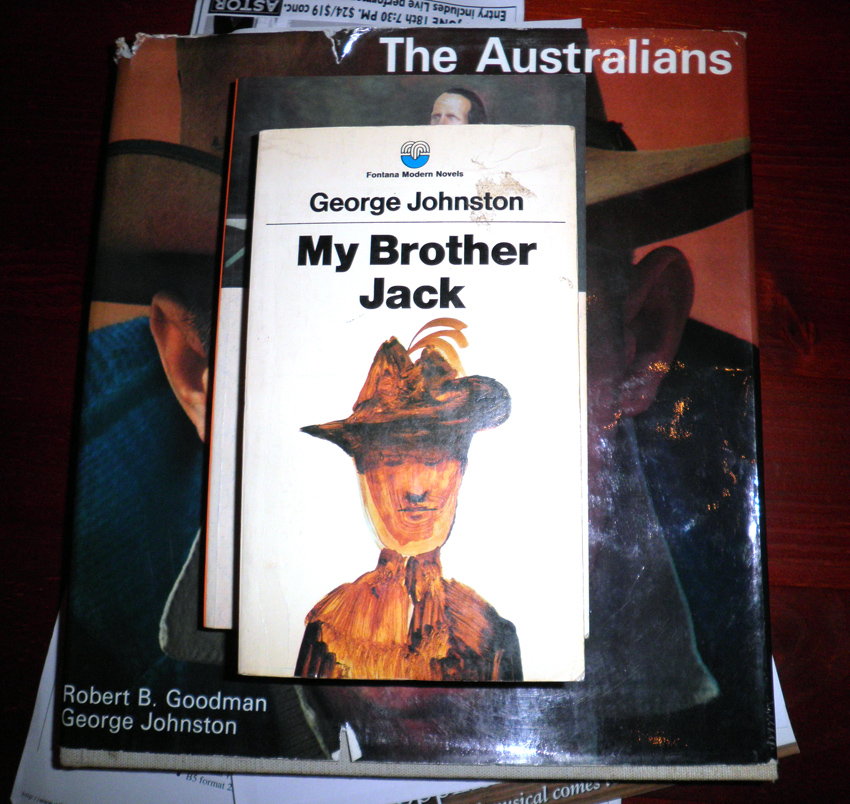
With my preference for first-person narratives – on my bookshelves they stand, spine to spine: Conrad, Defoe, Dickens…Gorky, Grass, Greene…Hemingway, Hesse, Huxley…Melville, Nabokov, Oakley…Proust on its own with the poetry – and multi-layered ironies, I can choose no other than My Brother Jack by George Johnston.

It’s a moving tale of a boy called David Meredith, born into a pre-WW1 Melbourne working class family, who squirms in the shadow of his tough, magnificent older brother. Enduring unprovoked beatings from a brutal, war-battered father, he manages to build himself a career as a writer and become a celebrated WW2 correspondent. Along the way, as he rises in the world, he sees his brother diminish into insignificance, in a sort of “good guys come last” vein. That’s the essence of the key points of the storyline, the surface.

A little below it is a thick layer of Australian history, from the descriptions of vernacular architecture, embracing the Edwardian and Between the Wars periods, to the recording of daily life in particular social and geographic settings of that era. My favourite part of the book deals with David’s time at The National Gallery School, housed in the Melbourne Museum. Nearly half a century later, in the Melbourne of my youth, much of that world still existed. Subsequently when it vanished, it was doubly heartening to know that it survived in Johnston’s book.

For me, the arts have always been the most engaging and significant record of history, from the paintings on the pyramid walls and Australian outback caves to the contemporary output of visual artists across the globe, and from the anonymous Peasant’s Song of prehistoric China to the disaffected pulsation of latter day western rap.

Scrape away a little more at My Brother Jack and you get a morality tale of human frailty, enough data for a text book on the psychology of families and a profound study of the nature of individual success as it came to be known in the 20th century.

But I like it for the plaintive irony under the swagger of the prose, whether in decrying the monotony of Melbourne’s flatness and attacking the city’s social fabric, or in the exploration of the narrator’s relationships with the different people, including love interests, in his life. While David Meredith tells us his story, I am not convinced that Johnston, the author, really knows what that is, which in itself fascinates me.

It is heartening to think that a book like this is a long term best seller and that it often makes it into “Australia’s favourite novel” lists. Another novel, whose prose I admire even more, that regularly appears in these lists is Christina Stead’s The Man Who Loved Children. My huge problem with it is that Stead set it in America, when the storyline is drawn from her childhood in Sydney and, valuing verisimilitude, I find the transposition deeply unconvincing. That, of course, brings us to all the vexing and fascinating questions about the nature of autobiographical novels, of which Australian literature has plenty.

And any venture that wants to promote vibrant and original Australian literary writing has my full support because literature is the best part of our rich, local artistic culture. That the venture is online, shows a serious interest in the future.

Blazenka Brysha

21/06/2010

Sweet Revenge

A Story by Blazenka Brysha

“Did you or did you not say: ‘Piss off, you little shit!’?” the magistrate asked, repeating his question.

From his vantage point as the accused, Trevor could see everyone in the courtroom. He looked at the six year-old child to whom he was supposed to have said this. The kid sat there with a bag of sweets in his lap, stuffing one lolly after another into his mouth and entertaining himself by surreptitiously kicking and punching the little girl who sat beside him. She was hitting him straight back. Their mothers were too engrossed in the proceedings to notice the children’s antics.

“I might have said that,” Trevor replied after some thought.

The magistrate went straight on, “And did you lift up that same child, Bradley Ecks, who is here in this court, and hold him over your head near the railing on the second level at Southland Shopping Centre and say, ‘Does action man want to take a shortcut to the lower level?’?”

“Yes,” answered Trevor, getting a bit flustered, “but only if he didn’t stop poking me with that sharp toy, the action figure thing, which is what I wanted to throw downstairs.”

When he was charged, Trevor hadn’t bothered to get Legal Aid because he thought he would not need it. He assumed that he would get justice by just sticking to the truth.

Yes, he had spoken, perhaps a little strongly, to the child who had persecuted him; and yes, he had threatened that same child, but it was done in self defence, after the child had repeatedly assaulted him. Trevor had already attempted to tell the court the whole story, so he resented the way the magistrate concentrated only on the bits that supported the charges.

When Trevor first started as a walkaround character with Henry’s CharactersTM, he liked the work better than he had expected. Dressing up as a chook, rabbit or bush animal and going about in public was closer to his training, as a dancer, than any other paid employment that necessity and Centrelink had forced him into, up to now. Donning the padded suits even inspired a new project, Outer Space, Inner Self, in which he combined various street styles of dance to examine human insignificance in the digitized age. It was a collaboration with a VJ friend who was good at getting small grants. They performed it in a dilapidated dance space, mainly to their friends, who really liked it, some even joining in.

After only six months with Henry’s, Trev was promoted to solo operator, when the company’s resources were stretched to the limit in fulfilling the promotion contract for the “Poss Possum” chocolate bar.

Trev liked the idea of spreading fun and chocolates. In practice, it was a tough gig appearing daily at four different shopping centres, for an hour at each. Although there was no Worksafe ruling on how long the stifling, cumbersome suit could be worn at one time, it was generally accepted in the trade that anything over 90 minutes could be seriously harmful.

But the work was not just hard, it was also thankless. So Trev found as he wobbled his big, foam-padded possum self towards a stroller, holding out a “Poss” bar for the little occupant, who unexpectedly shrieked in fear. As if that wasn’t enough, the mother would start screaming, “Get away from my baby! Can’t you see you’re making her cry?”

Mostly, the mothers apologised for their babies’ wailing.

“I’m sorry but he’s afraid of dogs,” one mother told him.

So much for all the effort he had put into developing his possum persona. He abandoned his marsupial head movements, which consisted of turning his neck sharply, then freezing in a stare. It had looked so good in the mirror at home, especially as the costume had high quality glass eyes. The wearer looked through concealed slits, positioned for human eyes.

By the time Trev got into his scrape at Southland, he had been doing “Poss” for nearly a month.

The combined effect of the school holidays and the mid-year sales, put both the shoppers and retailers on edge.

“Everyone just pushed and shoved,” Trevor had told the court. “It was hard going, I can tell you.”

But even at a quiet time Trev would not have been comfortable in a shopping mall. He was not a consumer and despised the religion of shopping, its places of worship and seasonal rituals. Trev didn’t mention any of this, just in case it cut across the magistrate’s beliefs.

He also didn’t mention the bit about nearly incinerating himself, which really added to his stress on that day.

He had wanted a smoke but couldn’t go outside because a walkaround character was never allowed to take off the costume head in public. It was one of the unbreakable rules of this commercial performance genre. Trev’s only option for privacy was the loos, although they were also part of the smoke-free complex. To his credit, Trev had considered trying to squeeze himself into his car in the carpark but he knew he wouldn’t fit without removing the suit. So, he had no choice.

Seated in a cubicle, his possum head on the floor beside his basket of chocolates, Trev puffed away peacefully. He didn’t notice a lumpy, burning bit of tobacco drop from the tip of his rollie. Suddenly the cubicle was full of smoke and Trevor was on his feet belting his smouldering sleeve with his bare hand. The sprinklers came on just as he reached down for his head and his basket. Hurried on by the ringing fire alarm, he brushed down his wet fur, which now stank, straightened his false head and made his way back into the crowd.

The costume was just singed over a large area but his nerves had been fried to a crisp. Although he wanted to get out of the place, he still had a lot of bars to give away. Experience had taught him that the best way to get rid of them, apart from dumping them at intersections when the lights changed, was to mooch along, ignoring everyone. That way he was never confused with collectors from the Wilderness Society, who dressed as koalas and carried buckets for donations.

The fear of being asked for donations blinded people to the difference between the limp, daggy koala suits whose hooded headpieces did not even hide the face of the wearer, and a state of the art, fully-sculptured costume like Trevor’s.

As he ambled along the walkways surrounding the cavernous atrium, children dipped their hands into his basket. His heavy suit was getting hotter and hotter.

It was from this point that Trev picked up his story for the magistrate. “I was nearly finished, so, I started heading off in the direction of an exit. I felt a sharp jab in my leg. I looked down and I saw that boy.”

He indicated the child, who was now sprawled across two seats and swinging his legs to kick the backrest of the seats in front of him.

“You mean Bradley Ecks?”

“Yes,” Trevor answered. “So I gave him some chocolates and some to that girl, too.”

Once again, the magistrate spoke, “You mean Cantrella Timms?”

Trevor turned his eyes to the girl. She was upside down on her seat, her legs against the backrest.

“Yes.” Trev was doing his best to play along. “Anyway, I tried to go but the boy just kept jabbing me with his hard plastic toy. As I gave him even more chocolates, the girl poured her drink on my foot.

“Then, as I looked around to see who was with these kids, the boy tried to set my tail on fire. He had taken my lighter from my pocket and was lighting it. I grabbed my lighter and tried to walk away but the kid jabbed me again. That’s when I told him off, which I shouldn’t have done because a proper walkaround character must never speak.”

“Why not?” asked the magistrate, intrigued by this legally gratuitous detail.

“It’s one of the rules. Speaking breaks the illusion.”

Trevor found it impossible to go on about the rest of what happened. He didn’t remember anything except the boy’s face as he held him up beside the railing. Having spent many hours hoisting dance partners into the air, Trev was used to hurling much bigger bodies about; picking up the child took no effort and it certainly got the kid’s respectful attention. Then someone screamed. Trev put the boy back on the ground and was nearly out the door when the security guard caught him.

Although the children’s mothers had not seen the disturbance because they were trying on clothes in an adjacent shop, there were more than a dozen witnesses statements against Trevor.

He was glad to have his boss, Libby Henry, vouch for him in person. She was highly groomed and wore a suit instead of her usual jeans. Trevor also dressed more formally for his day in court, donning a jacket that he bought specially the day before at the op shop. At the last minute he had decided against wearing his silk tie because it had The Cat in the Hat on it, which may have given the wrong impression. Libby had not removed the over-sized spider ring that she usually wore on the index finger of her right hand. She also did not tone down her bright lipstick. Although she was twenty years Trevor’s senior, she had retained a lithe body. No one would have been surprised to learn that she had been a Vegas showgirl and was a veteran of Disneyland.

She told the court, “Trevor was a reliable member of our Bush Friends troupe, especially as Barry, the Tasmanian Devil. I had been thinking of training him as The Count, one of our most popular children’s party characters. When all this fuss occurred, I had to suspend him from public appearances.

“But I think he’d been through a lot. The possum costume was ruined. It cost about $2,000; it’s very high quality. Going by the singe mark on it, Trevor would have been badly burnt, if it wasn’t made from fire-retardant fibre. However, between the burn mark and the soaking, it was quite wrecked. I had to make an insurance claim.

“I find it impossible to believe he meant the child any harm. He gets on very well with my dog, Petal, and Petal is never wrong about people.”

Hearing this, Bradley’s mother rolled her eyes and Cantrella’s mother stopped chewing her gum momentarily.

Under the circumstances, Trevor was grateful for Petal’s good opinion, especially since he had inadvertently nearly killed the dog by feeding it chocolate during the “Poss Possum” training programme. Boxes and boxes of “Poss” bars had been delivered for the promotion and everyone was getting into them. Trevor was having one after another and Petal sat transfixed in front of him. It made Trevor feel bad, knowing that the dog really wanted some. Petal was a small, hairy male and the only silly thing about him was his name. Trevor soon broke under the dog’s gaze and he gave him some of the chocolate. Then he gave him a little more and before long they were going fifty-fifty. It gave Trev a gut-ache and probably one to Petal, as well, since the dog vomited a litre of chocolate sludge on the carpet in Libby’s office. It made her very angry and she marched about demanding to know who fed Petal the chocolate and didn’t they know that chocolate can kill a dog? Trevor said nothing but felt, at the time, that it could kill him, too.

The magistrate glanced over his notes, preparing to finish the case.

He addressed Trevor, “Has it occurred to you how traumatic it must have been for a child to be lifted up like that?”

Trevor could imagine that it could be for some children but in little Brad’s case, it was merely enough to bring him to reason. However, Trev tried to appear as if he could suddenly see the magistrate’s point. He cast his eyes down, he stiffened his lips, he glanced up to make eye contact with the magistrate, for a second packed with remorse. All those years of dance training to become physically articulate now paid off. And Trevor was actually sorry: he was sorry to be caught up in this; he was sorry that he had to work in a ridiculous job that found him in settings he despised, surrounded by people he loathed. Yes, he was sorry.

“Nevertheless,” continued the magistrate, “I can see that you were put under extreme pressure. You reacted impulsively but without malicious intent.”

He put Trevor on a six-month good behaviour bond, with the condition that he was to get counselling for stress management.

Winding up the session, the magistrate spoke directly to the children, “You will pick up all those lolly wrappers on the floor before you go.”

The children ignored the order, leaving the clean-up to their mothers, who only picked up the biggest bits of rubbish.

On her way to the bin, the boy’s mother managed to tell Trevor, “You should have been put away!”

Outside, he caught up with Libby and thanked her. She pressed her lips together and nodded.

“Did you really want to train me as The Count?”

The question surprised her.

“Get real! You can’t handle six year-olds at Southland. The kids that want The Count at their parties would wash down their sushi with your blood.”

In the distance, Bradley and Cantrella bashed each other as their mothers talked beside their four-wheel drives.

“So there’s no work for me?” Trevor asked, to cover up his embarrassment at his naivety. He realised that Libby’s motive was to protect her business name.

“Not where children are involved. I’m sorry. But I might have something else,” she went on, guardedly. “I’m developing a Fred and Ginger thing with a show band for big functions. A couple of the girls would be good – Jenni, Lauren.”

“Jenni was my pas de deux partner at college!” Trevor blurted out.

“Also, I thought we could bring it up to date and go into a street thing…”

Now Trevor was excited, “Oh, cool. You haven’t even seen my street side!”

“I think I have. You mean that hip hop shuffle routine you were doing when you should have been cleaning out the store room?

“Need a lift?” she asked. Parking was tight and very expensive in that area. Trevor had trammed it. “Petal’s in the car. Don’t feed him anything, OK!”

ENDS

Jack Feldstein Interviewed

Jack Feldstein (photo Madeleine Maguire 2008)

Portrait of the Artist as an Artist

Jack Feldstein makes the most delightful animated films: writing the scripts, constructing the visuals, narrating the stories and even composing the soundtracks. With running times spanning from a few minutes to approximately half an hour, Feldstein films cover some very serious topics on the life and death continuum, including love and religion. They also contain quite a bit of nonsense, as befits any observation of daily life, and that makes them funny. They are multi-layered with irony, which sometimes also makes them funny and always thought-provoking. Feldstein is equally comfortable with a bizarre romp through classical Greek territory (Rescuing Oedipus Rex 2007, 19 min 24 sec), or a contemporary morality tale in a mundane setting (Rock Hard 2003, 2005, 6 min 44 sec). If you are not entertained by the diverting observations, you will be amused by the dancing skeletons (The Psychology of Script Writing 2009, 14min 40 sec). A Jack Feldstein film is a unique visual, aural and intellectual experience. It looks like a cartoon drawn in bright outlines on a black background. The images are a mix of original graphics and live action video mixed with filmed and graphic elements including cartoons from the public domain.

As creator of what is now known as neon films, Jack Feldstein is a new type of artist, whose emergence has been wholly enabled by the advent of digital technology. While he is a word artist who specialises in narrative fiction, using script writing as his primary medium, he has been able to harness digital technology to create a secondary medium through which he can realise his art in its totality, on his own. Although he still writes both plays and film scripts for others to stage and film, through his neon films, he can create whole works by himself. The films have found success internationally through various film festivals, opening up opportunities for Feldstein overseas. At the end of March he is moving to live and work in New York. I only came across his work last year through The Group Online Magazine (current issue features Feldstein’s The Ectasy of Gary Green 2005, 15 min 9 sec), and finding it intriguing, I was keen to discuss it with him while he was still here in Australia.

Jack Feldstein is an upbeat sort of guy and yet he has submitted to psychoanalysis. He ruminates intellectually but loves an easy laugh. A self-confessed talker, he is a sharp listener, wanting to ensure that he is answering the question being asked. This turns into an amiable wrestle as he throws questions back for clarification in an effort to pin down what is really being asked. He turned his back on his day job as a pharmacist – an area of very exacting, quantifiable measures and precise scientific formulas – for the giddy uncertainty of pursuing artistic impulses. In this interview he talks frankly about his work and his methodology as a creative person. After the interview concludes, he goes on to say, “For anyone to make any thing, you have to be brave. You have to have courage and you have to be gutsy, I wish it to you and I wish it to everyone. Obviously, I don’t always have it but I can see I need it and if there’s any sort of qualities for an artist, these are the ones and they will keep you positive without becoming embittered. I don’t mean to sound all namby-pamby and up in the air but that’s what I believe.”

INTERVIEW – recorded on Tuesday, February 9, 2010.

In the documentary Rebels, Radicals and Renegades: Jack Feldstein, you say your work is driven by an explosive urge. What sort of things set it off and what is the fallout, in practical terms. In other words, how does the genesis of any work begin and how do you tackle its realization?

The genesis of any work is that a person has to have something to express. They have to be very clear about what they want to communicate to other people, an audience, then if they’ve got that impulse, they will execute it. I can only speak personally and I think it is different for everyone – and I’m quite analytical – it’s something, a feeling that has to be translated somehow.

Take an example of any one of your works. What sparked it? Let’s take The Great Oz Love Yarn (2006, 4 min 57 sec)...

The Great Oz Love Yarn is about unrequited love. It’s funny and it’s silly and it has wonderful Australianisms. This is how it happened: someone spoke to me. I just met some random guy and he said a funny Australianism, like, you know, ‘a handbreak on a Holden’ and he was only young. It was wonderful and I said ‘How come you say that? Where did you get it?’ And he said to me, that’s what his grandpa used to say. The guy was only maybe 19 and he was full of these sayings.

Was he speaking about unrequited love?

No.

So, you just latched on to the expressions?

Yes and I love that they were uniquely Australian; it was marvellous, I felt. Then I did more research, I went and spoke to old diggers in pubs to get more. I went on a quest. As I spoke to them they would tell you a story and you’d have a beer and a bit of a yarn with them. One guy in particular told me a story, but not that particular story (ie The Great Oz Love Yarn), of unrequited love. I relate to that; I love unrequited love and resonate with it. That was the genesis.

Your first writing effort was a short story, followed by a play, then you became a script writer. You took that to a style of film making in which the script completely takes over, so that in effect, you are a writer who makes films. Why have you favoured script writing?

I’m born that way. I love scripts, I’m literary, I love literature. I truly believe a person is born who they’re born, with their own passions and their own likes and loves – and I have to say loves because I love it – and admire great scripts and plays, the writing of them and when someone does write them, I’m in awe.

Can I just jump in with a question related to this? You went through the first two decades of your life and became a pharmacist, then just turned around and became a writer. Why did your inner writer not come out before, or did he?

That is a perplexing question. I’m going to be very honest, I’m leaving the country now and I feel I have to be very honest. I duxed my school, so the curse of being bright, for a guy in particular, is that you’re pushed into the sciences and the maths. I was very good at maths and science, don’t get me wrong, and I love them but that was really the only option. It wasn’t presented that there might be other options that I could follow.

You were crippled by academic ability…

Absolutely, but I wouldn’t say ‘crippled’ that’s too harsh and I love the fact that I have that background.

Do you think that you will ever do a mad scientist animation? You’ve got a lot of information that you could tap into…

Probably. In the future I might use all that in a character; all that background could be really helpful.

In which year did you make your first neon film and what is it called? Was it Three Months with Pook, 2002?

Yes.

You describe your production method as ‘a combination of rotoscoping, computer effects and flash.’ You also use a mix of original live action video and other filmed material from the public domain. How much did practical reasons influence your choice of style (eg neon films as opposed to drawn graphics or all live action)? For example if you were a graphics artist you might tell your story just in pictures but neon animation combines lots of different things. Was that a practical choice?

It was practical and theoretical. I’d just finished studying at COFA (the College of Fine Arts, Sydney). I’d done the Theory of Modern Art and the Theory of Post Modern Art. I’d done the theory because I was fascinated by it and didn’t know much about it. So, I spent two years doing those courses. At the culmination of that, it opened me up because post modernism is appropriation and postmodernism was – because it’s now post-postmodernism – wonderfully freeing.

I was greatly influenced by postmodernism and learning about it. I loved it; I found it freeing and enlightening.

You don’t access government grants, how do you fund your work?

I have managed to sell my work in North America to cable television, not all of it, but some.

How did you do that? What is the process?

OK. My stuff was shown in film festivals, like Rotterdam and it was nominated for an award; it was out there in the world. In the Lincoln Centre in New York, one of my films was chosen and that was a huge help. Because of that it got some recognition and because of that, distributors approached me.

Can I ask how lucrative has it been? In Australia the population is so small that the creative artist struggles for an income from creative work.

It’s far more lucrative, if you look outside Australia. And that’s the reason I’ve not concentrated on Australia in this way; maybe I’m not such a bad businessman! At the end of the day, I’m not interested in the nuts and bolts but my mind tells me that a market with so many people in it is greater than the market here. So, I’ve concentrated on overseas because I’ve found it more rewarding financially. Also, through that, I got a producer in New York to like my work and he gets me gigs. So, if someone likes what I do, they hire me to do some stuff for them.

At the end of March you are going to New York. For how long ?

For how long? I don’t know…

You told me you have a Green Card. How long does that go for?

Forever.

Are you moving your whole household?

Yes, my partner is going with me.

Was it hard to organise everything?

What do you think (he laughs)? It is a huge, adventurous step but I look at it as an adventure. I’m a humanist, so I look at the world as one place; I don’t look at it as little nations. I love the idea of a cosmopolitan world. I know that it sounds like crap and that it’s ideologically ridiculous and naïve, even, but I can’t help it. I’ve studied in France and I’ve studied in New York and I can see like a big picture, like everyone is trying to do the same thing.

Yet your work is very distinctly Australian-flavoured…

Absolutely and which is as it has to be.

Judging by your work, your literary frame of reference is strongly highbrow, western cannon, Proust, Virginia Woolf, James Joyce. What else do you read?

I do read the Americans like Jack Kerouac…

But that’s considered highbrow, western canon…

Is it?

From a literary point of view, I’m afraid it is…

I read JD Salinger…What’s the question? Do I read crap? (he laughs good-naturedly) What’s the question?

Well, in my case, western cannon is my entire background but I also read what I call ‘trash journalism – for example in my childhood I read a lot of Women’s Weekly, Women’s Day, The Herald (a daily broadsheet).

Well, I’m not an exclusivist, a snob or an elitist at all. It’s just that I admire these people. I love the way these people write, they’re geniuses.

What about our own Australian geniuses, people like George Johnston, Katherine Susannah Pritchard…

Absolutely, as well.

But they’re western cannon highbrow, which is interesting…

Great musicians are to be admired. Anyone great in any area is to be admired. When I read something, or when I’m affected by something else that someone else has made, I’m in awe of it and I do my little bit to show that. I do it tongue in cheek as well, I’m humorous.

Going on from that, what films do you enjoy and which do you admire – are they the same? I ask that because I very much enjoy Hong Kong action movies (Jack: “Ouch!” roars laughing) and up to a point admire them but then there’s that whole ‘great films’ thing…

I enjoy animations, like all the Pixar ones. I enjoy them greatly and there’s a spate coming now that are not even Pixar, they’re Dreamworks, everyone’s trying to do it.

How do you regard a film like Avatar, which is lauded for its technical achievements and whose content has an anti-militaristic and environmentalist thrust? You obviously admire it technically…

I have no problem with the script, it was adequate, on a technical level it was absolutely fine, it served it’s purpose of hanging a marvellous, genius visual experience on it. Politically, you’re asking me? Politically, it was very interesting as a metaphor, it worked to get people to think. And it’s interesting because it got everyone to put their own interpretation into it, which shows me that it’s a very universal, classic piece. Like Oedipus Rex. It’s not just a story about Oedipus and his mother, it becomes universal from the specific.

Avatar is a populist triumph but at a serious critical level the concept of ‘populist’ is a very troubling and ambiguous one that now carries a pejorative overtone. You touch on this in your delicate treatment of religion in The Populist Adventures of Jesus (2007, 2 min 54 sec), in which Jesus, then Moses and Mohammad become Holywood celebs and inspire their followers to replace weaponry with consumer goods like fancy TVs. What’s your position in relation to all this? You say you use humour but that’s an interesting position because, for example, Jesus becomes a popular celebrity, which is something that you might question…

Well…OK…what’s my position? Clearly, it’s as in the film, in other words, it is an ironic situation because I see the irony behind all of it, behind celebrity…I try not to judge too much because, to be very honest, to judge is already to not be an artist. An artist accepts, accepts what the world is. To judge it, is already a little arrogant. Thus, perhaps to point out some ironies of situations, I’m gentler than a harsh political artist. However, there are huge ironies and absurdities…

That you do like to expose?

Yes, and that’s how I see the world as quite absurd. My political view of the world is: absurdity.

That takes us to the next question, which is about psychology. In The Psychology of Scriptwriting you identify various psychological profiles like autistic fantasy, narcissistic, id and empowerment theories that can be used to categorise script writers. When my sister saw the film she wondered where you would see yourself fitting?

I fit in all of them. I’ve got a little bit of all of it in me. My partner is a psychiatrist and I’ve had quite a lot of therapy and psychotherapy. I’m not averse to it and I’m not scared of it. It’s not taboo for me either.

Can I ask, why have you had a lot of psychoanalysis?

Because I think it’s a luxury to have been able to work things out that were perplexing me. And rather than continue to make the same mistakes, I wanted to make new mistakes. Psychotherapy seemed very helpful to me.

As an aid to personal development?

As an aid to understanding why one might perhaps do what one does and being able to change it. It’s an aid in changing.

In this day and age there’s a lot of so-called mental illness – I use the term to define things like depression, bi-polar condition – would you have suffered from any of those to a clinical level? Or have you gone in for psychoanalysis because you were just interested?

A clinical level? OK, you’re asking me a medical question and I’m going to answer it as a medical person. At a clinical level, let’s say, I would have had the odd bit on medication and in a…

In an institution, for want of a better word?

No, that’s not my background. However, I am disymic or cyclothymic, which means sub-clinical. Now everyone is on a spectrum of everything. Now cyclothymic, it’s not bi-polar – people can be moody, up and down but not manic and comatose. But I think that any creative person must face themselves, and back to the psychotherapy, it’s really facing oneself. It’s probably what every artist must do because you have to grapple with yourself, every time you sit down. Psychotherapy has helped me do that.

Were still on the feelings side, psychology – your films are irrepressibly positive, even Virginia Woolf snaps out of suicidal depression (The Adventures of Virginia Woolf, 2007, 3 min 29sec). Is this positivity something you deliberately engineer?

It is something I aim for. I try not to be a nihilist or to let the negative darkness…look you can always choose, even an existentialist can choose, where you go in life. The choice of positivity is, I believe, helpful to people.

Your work is also riddled with ambiguity and multi-layered with irony. You have Proust engaging with a Proustian memory sequence as he struggles to remember something important (The Adventures of Marcel Proust 2007, 3 min 47 sec). Your James Joyce is in a prosaic funk and offered as a purile whinger, slagging off Hemingway but quoting a few vindicating words from Ulysseys (The Adventures of James Joyce 2007, 2 min 51 sec, co-written with Daniel T Metz). How easily does this stuff come to you and how much do you have to work it into shape?

How does it come to me?

Yes, do you just start with a strand, does it come as a grand revelation? How easily does it come to you?

How easily does it come to me?

Are you ‘exploding’ all the time? Or, do you have big patches of no erruptions?

OK. Often I’m exploding. When I say I’m cyclothymic, obviously there is a time when I’m not – there is a cycle – but let’s say 75% of me is more of that explosive nature. Then there’s the 25% that is hopeless.

Then let’s get back to the idea of how you work it into shape. There’s the old adage that ‘genius is…

Rewriting!

1% inspiration, 99% perspiration…

Yes, of course, and I believe that. How do I get it into shape? I just do it and then I re-do it.

Do you work long hours at a stretch?

Yes.

So, you’ll stay up till ridiculous hours?

Yeah, all of that.

How does your storyline evolve: does it work towards a conclusion or is the conclusion the result of the way the story unfolds? Do you sometimes start with an idea for a conclusion and work up to it?

No. I try for a conclusion that is organic from the story.

In The Adventures of J.D. and the Rye Guy (2009, 4 min 52 sec), Mr Antolini, the possibly pedophillic and therefore controversial character from The Catcher in the Rye, is offered as a model in that the Rye Guy becomes like him. Tell me a bit about that?

That character is very strong and disturbing (in the novel).

From your animation, I thought I must have remembered it wrongly…

No you were correct in that he (the Rye Guy) turned into a possibly questionable character…

But your version is this happy chappy with a cocktail…

Well, I’m sure he was that because a ‘happy chappy with a cocktail’ could be fiddling about very easily.

So what is your position on him? Because you do say you find him creepy.

Of course, he’s creepy!

I found him creepy; kids don’t like someone touching them…

So did Holden! It’s an ironic situation. Sometimes a person becomes something creepy and I’m sure that a creepy fellow didn’t start off as a kid thinking he would be. He would be horrified to think that that’s what he would turn into.

All your animations are narrated. How much is the narrator you? The words and voice are yours but how much is the narrator a created character? I’m thinking specifically about Rock Hard because you presume that the narrator, who is telling the story about himself and has a peculiar fetish for female pubic topiary, is a creation.

It is a creation. It’s a creation that I understand. As someone who makes things – even the word artist is so weird now – I try not to judge. The more I can understand everybody – of course, that’s impossible and I’m setting myself an impossible task – but I’m trying to understand everybody and the more I understand all sorts of people, the better I’ll be at presenting them.

So, how much is the narrator Jack Feldstein and how much is the narrator a creation that morphs from animation to animation?

It’s a hybrid. It’s not me, you’re talking to me now, which I am similar to my animations and I do talk at a million miles a minute and I love ‘highbrow’ intellectual sort of stuff, and funniness and absurdity and all those things, as you can tell as we’re speaking. I’m a very playful person. Verbally.

However, do I have a schtick about (pubic topiary)? No. However, a friend of mine did.

The moral of this animation seems to be: “judge not lest ye, yourselves, be judged….”

That is exactly right.

So, there is a moral there but you’re not judging and yet it is about judgement. That’s what I’m talking about when I refer to the multi-layered irony…

And I do believe that – be careful with your judging, ‘lest ye yourself be judged.’ Just be careful when you’re being arrogant and judging and harsh because it could be that one minute you’re not that and the next minute you are. Like with drug addicts or whatever…

Boy George was like that, he proclaimed his love for a cup of tea and then he became a heroin addict…

It’s the same with everybody. It’s like The Bacchae. The Bacchae is one of my favourite plays because that is the moral of it. He (Pentheus) tries to stop all the dionysian cavorting but instead was consumed by it because he wanted to see it. He thought he could just see it and keep away but that’s not the truth because as soon as you look at something, you become it in a way. We’re not as compartmentalised as we think. The Bacchae is a very psychological play; it’s a genius play actually.

Your sound tracks, which have a whimsical digitised quality, are never credited so I presume that you create them yourself along the lines of your use of public domain image. Is that so?

Yes and I also compose my own music.

Do you have a formal musical background?

No, not at all.

Your work is better known overseas than in Australia. Does that bother you?

Does it bother me? It wasn’t my plan; I had no idea that that would have to be the way.

But does it bother you?

You see, I’m not answering the question. It would be nice (to be recognised here), it would have been easier for me, if it had worked out. But that forced me to look elsewhere, so, it’s a blessing and a curse. The curse is that it would have been nice; the blessing is that it’s forced me to look overseas, to go there and to sell myself there and to succeed there, which is not a bad thing. My rational mind tells me that I”m not the only one in this situation – there’s lots like me. My positivity tells me, look, you were forced to do this and you did it. But my heart, because I am Australian, would have liked it.

So, you still love a sunburnt country, despite everything?

How could you not?

What work are you hoping to produce in New York?

Well, I’m a film maker and a script writer as well. So I am going there a lot for my scripts and I hope to be working as a script writer as well, just a script writer because I do love it.

And scripts for films?

For films and theatre because I love theatre as well. So, I’m going to explore those areas; I’ve got a lot of scripts, that I’ve written, in my draw, that I have not sold or done anything with because they’re not for…the challenge is too much for me here but I know that overseas, it’s easier for me. I don’t know why and I can’t explain it.

The photograph of you to be used with this interview, you say ’emphasises your aesthetic.’ Tell me a little about how you relate to that photograph, which shows your back and shows you in front of the Warhol famous soup can work at the Museum of Modern Art in New York.

When I did that course of modern art, pop art really impressed me and I loved it. I’d always loved it but learning about it really made me love it more – really as an epiphany, as an explosion. I ‘get’ pop art and my films are time-based pop art.

When you say ‘time-based’ what do you mean?

Andy Warhol did visual art, which is stationary. Time-based is just a term for any sort of filmic work over the time axis – work that is not stationary. And I love it so much. When I love something, I appropriate it or I transform it with my own direction.

One question has just occurred to me in relation to time-based work. All artists, all creative people self-edit, deciding what they are putting in and what they’re not; I’ve come across an interview with you in which you talk about script writing and not being precious, about throwing stuff away. Now I’ve noticed that your films vary greatly in length. They can be only a few minutes or even half an hour. I guess I’m asking how long is a piece of string…

The story tells you how long. The narrative tells you if you’re open to it.

In A Wondrous Film About Emma Brooks (2006, 17 min 36 sec), the bird tells Emma that ‘the truth isn’t in words.’ Where is the truth for you?

It’s in actions. The truth is in actions, which is ironic as well because I’m full of words but I’m well aware that the truth is not in my words; it’s in my actions and not just me but everyone.

So, your art is not true?

No, the art is true because I did an action, I made the art.

Blazenka Brysha
27/2/2010

Ends

Some other films by Jack Feldstein

Computer Games (2006 5 min 17 sec)

Headbin (2004, 12 min 51 sec)

The Loser Who Won (2006, 20 min 18 sec)

The Atomic Adventures of Jack Karouac (2007, 5 min 26 sec)

Fantastical World of Script Writing (2007, 32mins)

Dragon Dance Welcoming Year of the Tiger

Springvale Chinese New Year Festival, Sunday, 7 February, 2010

The best way to welcome a New Year is with a Dragon Dance. If you want to go all the way, include a Lion Dance. That’s the way the Chinese do it and when it comes to pageantry, colour and symbolism, they can’t be beaten. The dances not only add fun to the festivities but make double sure that the coming year will be a good one, filled with health, happiness and prosperity. Touching the dragon is considered particularly lucky, which must mean that taking part in a Dragon Dance is a fortunate opportunity, indeed.

As luck would have it, that’s exactly what happened to us when our martial arts teacher, Sifu Dana Wong, sent out a distress call for help with the dragon of the Federation of Chinese Associations (Vic) Inc., when regular members of the dragon dance team were unable to come and person power was needed for a gig at the Springvale Chinese New Year Festival last Sunday night. Big Bruce, as this dragon is affectionately known, was a gift to the Federation from the Chinese consulate and is intended for use both as a dynamic manifestation of living tradition and as a cultural artefact reaching out to the community at large.

Working Big Bruce, last Sunday, was a workout and a half as we stomped and lunged, twirled and plunged our serpentine way through streets and shops in Springvale. Big Bruce dived and rose through a sea of happy faces, delighting the crowds with energetic serpentine antics, propelled by the power of a big, beating drum, a banging gong and the crash of cymbals. This powerful dragon took his work of scaring away monsters and paving the way for good luck very seriously, indeed. Big Bruce may be made of cloth and hoops and sticks but it was us humans who were the props.

Big Bruce waiting for showtime.

Dragons come in many lengths. This three-stick dragon has impressive mobility.

The two-stick dragon shows that a little dragon is lots of fun.

Both Dragon Dance and Lion Dance belong to the realm of Chinese martial arts. Sifu Wong, who heads Qian Li Dao Academy, explains, “Dragon dancing is a multi-faceted gem that reveals an integral part of Chinese culture through physical expression. Twirled within its weave of movements are ancient traditions combined with fitness training and martial arts. The expression of age-old beliefs and customs is preserved through the generations via the dance, while also providing an opportunity for fitness and the development of martial skills. The dragon dance symbolises longevity, prosperity and the search for eternal knowledge. Through participation in dragon dancing, anyone can contribute to the community, get healthy and learn a bit of culture along the way, but FUN is the icing on the cake!”

While there’s a lot to understand and know, fun is the integral component that our rough and ready troupe had down pat. Unlike the western dragon, which is presented as a monster to be slain, the Chinese dragon is a sacred creature of great power and benevolence. Its appearance is as complex as the cultural depth that informs it. With its serpent body, fish scales, eagle claws, tiger paws, camel head, bovine ears, stag antlers, clam belly, monstrous goggle eyes and human whiskers, it is a composite of all creatures and can move through water and air, as easily as on land. This dragon is your most-valued friend. We got that message across, no worries.

Just as the dragon has nine different creature components – the whiskers are not counted, except in my personal observation – so Big Bruce needs nine handlers. However, many parade dragons are much much, longer – the Melbourne Millennium Dragon being the longest in the world – and some are quite short. At Springvale, Big Bruce performed with several other two and three-stick dragons. In one glorious sequence, all dragons came together, rising majestically in support of the Lion Dance victor, as it reached high to snatch the victor’s prize of lettuce and money dangling from the veranda roof of Walrus Seafood Restaurant. In a kung fu miracle, my wing chun skills enabled me to take a snap of this magnificent moment although I, too, was ramming a stick into the stratosphere.

Lion Dance is performed as a competition between two lions, each one worked by a team of two very acrobatic performers. The lions appearing with us were the Melbourne Quan Anh Lion Dance. The dancers received some last minute coaching from the dazzlingly athletic David Tang, who cross trains in various martial arts including Choy Li Fut and Hung Gar. He lead both lions and dragons, working the dragon’s pearl – the spherical, flame-edged object of the dragon’s pursuit, symbolising wisdom, prosperity and universal energy as expressed by the concept of chi (Qi). It was a merry, exuberant dance as David leapt, spun and dashed about, wielding a sceptre topped with the enticing pearl. Sometimes he would throw himself down onto one knee and make the dragons jump over the pearl.

David Tang demonstrates a move.

David Tang (left) and La Wren Wong watch as the lion dancers practice removing the prize of cash strapped to lettuce.

David Tang in action with the pearl.

Red Lion dancers at the end of their gig.

As with all dance performances, the big no-nos are tripping up and not staying in step. The first we managed; the second proved much more difficult. Keeping the serpentine undulations of the dragon’s body synchronised in canon sequence requires great skill and much practice. Our effort was more of a jolly wobble and a reckless sway. At one point, when we swooped to round a corner, I nearly decapitated a performer from another troupe. Then there was the thrillingly perilous stampede through restaurants, in which we had to duck through doorways and dodge overhead fans.

In the case of our dragon, as with most things, the middle bit is not nearly as important as the beginning and the end. Working the head and tail of a dragon require considerable expertise. Big Bruce’s head weighs at least 15 kg. Hoisting it about in a dance that requires aerodynamic manoeuvres is an enormous physical and aesthetic challenge. Fortunately, Steve Colebrook, a professional musician, long-time martial artist and practised dragon dancer, was able to draw on the appropriate range of skills to do Big Bruce justice. The tail, which needs to move horizontally and vertically at the same time, was handled by La Wren Wong, another senior martial artist of long-standing experience in a range of movement arts. Handling Bruce’s head or tail is so abrasive to the hands that it requires the wearing of protective gloves.

La Wren Wong (left), who worked the tail, adjusts her protective glove. Steve Colebrook holds steady the 15kg dragon head.

The Springvale Chinese New Year 2010 Festival closed in the dark of night with a spectacular performance from all the dragons in front of the community stage in one of the large carparks. Fired up by the banging accompaniment, the dragons charged into the bright light, weaving in and out, over and under each other, creating patterns of brilliant colour and an atmosphere of exploding energy. The new year would be a good one.

Happy Year of the Tiger.

Dragons going home.

Blazenka Brysha
14/3/2010

Postscript
Big Bruce’s next gig will be at the Glen Waverly Chinese New Year Parade on Febryary 28, then at Werribee annual festival’s Weerama Harmony Day parade, on March 14.

All the photos

It’s Only Words – Occasional Interviews

Throughout history, art has been the most interesting and meaningful record of humanity’s existence. Yet art not only reflects the world that produces it, but also taps into its time to invent the future. So Daniel Defoe’s A Journal of the Plague Year(1722), which offered fact in the form of a novel, becomes the precursor of serious modern journalism. Paradoxically, his fictional Robinson Crusoe (1719), the best-known book in English for a quarter of a millennium, was often regarded as fact. Much closer to our own time, we only need to consider the effect of Japanese manga cartoons on popular culture and how they have shaped the aesthetic consciousness and appearance of youth born into our post manga world. However you look at it, humanity’s consciousness is infiltrated.

What interests me is how artists interact with their time in history to create something new. In this series, I want to intercept the artist at the point of that interaction and discuss the work that has resulted from it.

When I spoke to film maker Jack Feldstein about the possibility of doing an interview with him, he said, “Oh, is it going to be a series?” His supportive ebullience caught me off-guard and I stammered my way out of it. But the artist in Jack is a bit psychic because, in fact, to interview Jack, who is moving to New York in March, I had to put off the interview I had pencilled in for February, with artist and sculptor, Darien Pullen about the sandstone studio he has built for himself. The building in question is a work of high art: pristinely aesthetic, puritanically functional and so environmentally friendly that it could be a blueprint for sustainable living beyond the pet-cage wheel of earn-spend-consume-earn-spend-consume.

The interviews I want to produce are made possible by digital media and the luxury of cyber space, a sprawling universe of technological possibility that allows comprehensive recording and automatic full illustration of the subject matter under discussion. So, it’s not really only words, but words are all I have to address something more that can now also be conveyed.

Blazenka Brysha
February, 2010

Jack Feldstein Interviewed will be on line March 1

Jack Feldstein (Madeleine Maguire, 2008)

Confessions of a Petrolhead Wannabe

The Batmobile

It’s not that I want to be a petrolhead; it just looks like I do, if you consider my recent vehicular history. Actually, I am far more into history than cars but the reality is that if you want to get around a big city like Melbourne safely and efficiently at all hours, you have to drive. Perhaps a more honest title for this would be: Motoring Mistakes I Have Made – grand errors and regrettable lapses, just trying to get from point A to B.

I learnt the word “petrolhead” at The State Theatre when a fellow dance reviewer called me that as we were milling about before the ballet. I was bemoaning the departure of Bill Tuckey, former motoring editor from his newspaper, a rival broadsheet. “You’re a petrolhead!” my colleague declared without telling me exactly what happened to Bill Tuckey, who had a very funny turn of phrase. I had ample opportunity to familiarise myself with Tuckey terminology because at the time, I was also working, in a most lowly capacity, on a trade publication for the motor industry. Trade publications are the cannibals of the press and live by stewing up information quoted from other published sources. Often quoted, Bill Tuckey was funny and funny is good, always. If I thought there were any jokes in Tuckey’s 1987 classic, “The Rise and Fall of Peter Brock” I would track down a copy and sink my fangs into it.

When Brocky died, I pretended to care, deeply. I was driving my white manual Barina City, 1996, known as the Batmobile. I was on Glenfern Rd, Upwey, with the densely verdant foothills of the Dandenongs on my right and the rolling grazing fields of Lysterfield on my left, when I got a call from Bill Allan, my octagenarian tenant at whose place I had just been ten minutes before. “Peter Brock’s dead!” he announced.

No way!” I exclaimed right back, top of my voice because my hearing is not good and my handsfree mobile phone technique is even worse. The undulating road rose and fell beneath the Batmobile’s small but nimble wheels, as Bill filled in the bare details.

Brocky had wrapped himself around a tree during a rally. As I was in a simulated rally terrain, I drove with even more care. The legendary champion, by then over sixty, was now retired for good. Bill said all drivers on the road were turning on their headlights. I joined the throng. Maybe I had never seen a car race. Maybe I was opposed to having the Grand Prix at Albert Park Lake reserve and had made a protest sign, which I taped to the rear window of my white, manual Suzuki Swift sedan,1992 : “Ducks can’t wear earplugs,” but the death of a legend is serious. Likewise, Bill Allan was a Ford driver while Brock was Holden, but at that moment, it didn’t matter. I was transfixed by the irony of Brock having such an exemplary fit body – and not just for his age – at the time of his death. Also, I couldn’t believe it was an “accident”, especially since the rally passenger escaped, not just alive, but relatively unharmed. I only formed my suicide theory later. I also firmly believe that Princess Diana was definitely murdered.

In fact, it was my inappropriate reaction to the latter’s death that made me treat the deaths of celebrities with sensitivity. Normally, I don’t listen to the car radio but at the time of Diana’s car crash I had just done a live radio ballet review, so, driving home, I listened to the Sunday arts show for which I worked. The news of Diana’s car crash came through. “Wouldn’t it be good if she died!” I said, wide-eyed about the press feeding frenzy this would inspire. Then, Diana died and my daughter accusingly reminded me of my terrible words. She did this more than a few times. It was pretty hard to explain that when I said what I had said, I wasn’t thinking about Diana, the mother of two young children etc, but rather of the soap opera character that she had created in collusion with the press. That was the last time I would fall into such callousness.

Brocky’s death was no joke. Crocodile cuddler Steve Irwin had only died just before, so it was two legends in a rapid row. I immediately rang my sister Marta. Her husband answered the phone. I warned him not to do anything dangerous because we were now two legends down and there was bound to be a third. When my sister took the phone, I told her the news – no, she hadn’t heard and she was almost as hard hit by it as me. Actually, she’s not much into sport. For instance, I might say something about Ricky Ponting captain of the Australian cricket team – in whom I started taking a wary interest after I heard him declared, “the most dangerous man in cricket” which made me ask, why haven’t the police picked him up? – and Marta says, “Who’s Ricky Ponting?” to which I can say, “My point, exactly.”

Marta’s real soft spot is football. Her love of the Collingwood football club goes way back to when she was in her late teens and studying cello at the Victorian College of the Arts, when it was a proper performing arts academy focused on the arts as practice rather than essay topics about arts pracitce. We had gone to The Club in Smith St Collingwood to see a band called INXS because a former English student of mine was going out with the lead singer. As nightclubs were the only places you could get an alcoholic drink after 10 pm, they often attracted a seedy drunken element among the desirably well-heeled, young patrons. If the drunks caused no trouble, they were welcome to spend as much at the bar as their guts and bladders could hold. We were waiting for the band to come on, when a drunk siddled up to Marta. He wore a shabby, brown overcoat, was unshaven and had some grey through his messy hair. Today he would pass for the new, high disposable income inner-bayside residents who are only distinguishable from the homeless by their Audis/BMWs and pricey joggers.

The chat-up went like this:

Collingwood did good today,” he began, balancing himself by the beer glass he was clutching.

I wouldn’t know,” replied Marta coldly, as the rest of her party moved away, laughing politely.

Doncha follow the Vee-eF-L?” he asked, stunned that he had wasted such a gem of a pick-up line on a non-believer. We were in Collingwood territory and the Magpies had won that Saturday!

No. I think football is for morons.”

Was the gentleman admirer an idiot savant who opened Marta’s eyes to the aesthetics of football or it a cosmic irony that nowadays, when the Victorian Football League has stretched itself across the nation as the AFL, most of Marta’s pets are in the Collingwood club colours of black and white?

When I passed on the news of Brocky’s demise, I was driving a Holden. They had come a long way since my first driving lesson when a Mr Dowd from Ronald’s Driving School made me sit on two phone books so that I could work the pedals of his Holden sedan, which fortunately had dual controls. My Batmobile can transport six saddleback timber chairs in one trip but I bought it because it looked nice. So, although I passed for a petrolhead at the ballet, I clearly didn’t think like one. Colour is very important, too, and I can really only drive white cars. And that’s probably why I can’t drive my red Mustang much, if at all. It also partly explains why I have even more difficulty with my Subaru Impreza, which is called “white”, but the metallic, gold underlights make it a very pale pinky cream.

Of all colours, white is the most controversial and colour experts will tell you that it isn’t a “colour” at all, nevertheless, it happens to be my favourite colour and my panacea for all grief. Nothing is more therapeutic for me than an hour spent in my totally white laundry, washing “whites”. So how do I come to own a red Mustang or even a Mustang at all? Aside from the name and my strong identification with horses – unlike most people, in former lives I wasn’t a queen or Julius Caesar or even a human, judging by my incompetence at being one currently, but I do believe I was a horse, perhaps a mustang, but definitely a wild horse – I also think it looks nice. My first mistake, aside from buying the car at all, was being honest about this when sourcing insurance for the car.

I learned quickly that only a specialist insurer would underwrite a fully imported car, so I rang Shannons “Specialist Insurance for Motoring Enthusiasts.” I was asked questions that I can’t remember now and then couldn’t answer. No, I wasn’t in any car club, had no affiliations with any motoring apart from private commuting and when I had a flat tyre, I called the rescue service (or RACV road assist, as it’s known in the trade). My interrogator finally asked, “WHY did you buy the car?” Sensing his exasperation, I attempted to be as pleasant as possible. “Because it looks nice.” This was not enough for Shannons, as I had failed to demonstrate that I was an enthusiast. Lucky for him that I had refrained from demonstrating my no nonsense, “Jeez, you don’t muck about” side, which actually would have ticked all his boxes and gone something like this:

Listen,” I would begin in a tone that implied, “Listen, shitbag, I’m the customer here!”

… if you can’t help me, could you please put me through to your manager or someone of enough seniority to handle my request. Correct me, if I’m wrong, but yours is an insurance company for imported cars, which my car is. It is a Ford Mustang, 1994, 3.8 lt V 6 automatic red coupé righthand drive converted with 61,000 km on the clock. The kilometers are genuine, it has never been in an accident, it came into Australia from Japan in 1997. Obviously you have no idea how hard it is to find a Mustang 3.8 lt V6 auto in Australia. Everyone wants the 5 lt V8 manuals but have you ever tried the clutch on those? I normally don’t drive autos because I use the clutch to work my abdominal muscles and keep my gut flat.

And yes, it’s true, if I could have bought a 2 lt 4cyl manual version of the same Mustang made smaller but retaining the same proportions as the 1994-1998 model, I would have. That model was 4610mm long and 1884 wide and I believe one of the shortest Mustangs ever. The shorter the car, the better for parking, the easier to manoeuvre and I don’t have to tell you about the importance of avoiding damage to your car. You’re in insurance, I am a RATINGS 1 FOR LIFE driver. When I get my insurance renewal notices, I get an “AAMI Award for Excellence in Driving” sticker, which I normally toss but I have now put on my Barina to let everyone (“shitbags like you,” – implied) know that my driving is praised in some quarters.

But it’s not just the length of this Mustang. It’s also the proportions. The model is part of the Fourth Generation design, which took the look back to the classic 60s coupé – don’t start me on the fastbacks (fancy term for a hatch), I think they are really ugly like deformed slugs – and was produced from 1994 to 2004, however by 1999, the car became longer by 42 mm(4653) and narrower by 27mm (1857). That might not sound much different to you, but it is to me because I bought the car “because it looks nice.”

I wouldn’t have even bothered to start on the pony badge on the car’s front – a magical silver silhouette of a stylized horse, all hooves off the ground, tail flying, my idealized self-portrait. After many years of reviewing dance and bonsaiing my intellectual property for the unfiltered readership of the daily press, I’m very careful with whom I discuss aesthetics on an equal footing. So, luckily, I didn’t say any of the above because Shannons are very expensive insurers and ponce about with all sorts of demands, according to a woman I know who likes and has owned big American classic cars from the 1950s.

Then I rang Torque Insurance and found that, indeed, Torque is cheap. The man there was so nice that I let him look at my car via email and he said it looked really nice. There’s too much nasty in the world these days. I loved everything about Torque. When the soothing man asked how many kilometers I intended to drive the Mustang per year, I volunteered “100 a week?” Being innumerate, I had no idea but have since leaned that it’s not even 50 a month. I know this because Torque was taken over by Lumley Special Vehicles and they want an annual odometer reading.

When you buy a car because “it looks nice,” it should be obvious that you mainly want to “look” at it. Is that so wrong, even if it is surprisingly fuel efficient and inexpensive to maintain? But my Mustang isn’t just beautiful on the outside. The horse logo is repeated on the steering wheel. On the rare occasions when I drive the car, and I’m putting lanolin on my hands, I rub a little on the pony and make him shine even more. I love that little pony.

I discovered the cosmetic benefits of lanolin after running my hands through a sheep’s fleece while the sheep was still wearing it. My genuine fondness for sheep has not lured me into buying a Jumbuck ute “the toughest little half-tonner in town,” cute as they are, because they are front wheel drive and, since I even get bogged in rearwheel drives, for a proper workmobile, I need an all-wheel drive. If I was a real petrolhead, I would be able to take off at traffic lights on slippery wet roads without spinning the wheels and freaking out about some hotfooter ramming it right up my exhaust. Nor would I be getting bogged on rough roads that the towtruck driver assures me would be no problem for an all-wheel drive. You only need to be bogged a few times to accept that you genuinely need an all-wheel drive car and that’s why I have one. It’s an Impreza, a word that has become my synonym for anything that gives me a headache, which the Impreza literally does.

This car, the 2007 hatch – not the old sportswagon style that I had gone to buy two months too late – but the new super safe model that has so many air bags stuffed into it, you cannot see out of the car because the front pillars are so wide and the doors and the dashboard are so high. Even when I jack up the seat high enough to see a little better, making my legs bang against the steering column, visibility out of the car is still so poor, it strains my eyes and leads to headaches.

The front seats are designed for slouching and if you have a strong straight spine that will not be distorted to fit the curvature of the seat, the headrest bangs into the pressure points on the back of your head. This also leads to bad headaches. I have addressed this problem by swapping the front headrest for one of the smaller straighter ones from the rear.

Pity I can’t swap the clutch, which is oddly sensitive and does not release until about half way out. Don’t try fiddley reverse parking in busy city streets. Take extreme care at the lights or you’ll get rammed up the exhaust. And speaking of exhausts, the cabin ventillation is abysmal except for the mysterious draught that still blows on your feet from under the driver’s dash even when you have the heater on. The first time I froze like this, I took it well and instead of selling the car, which had been my first impulse, I went straight to a shoe shop and bought three pairs of different types of boots to cover different occasions and different degrees of cold. “Turn a negative into a positive,” is one of my motos. Two winters later, I still love and wear all those boots and I still hate the car because, although I have warm feet, I can’t get enough air for breathing. Unless I open the window at least half way, the slope of the window glass scoops the outside air up over my head while all that comes from the air vents is the stench of plastic and some feeble puffs of warm air. Maybe you are supposed to use the air-conditioning, which I can’t because all air-cond gives me a headache.

The car’s factory-fitted battery was a mega-problem. If you didn’t drive the car for two weeks, it would go flat. Trying to discuss the problem with the Subaru service people was impossible because the service phone number is not linked to any service department, it is merely a service appointment booking line. If you only want to ask a technical question, you have to take the car in for a service because the telephonists know nothing about cars and can’t let you speak to anyone who does. As I had already been through this whole process after a dashboard light played up, I couldn’t bear to be mucked about so painfully again. The light in question is one that shows the car in a wobbling position; according to the manual, if this light comes on, you have to contact the service department immediately, which I did. When I took the car in, they tested it at length, found nothing wrong and sent me off, saying that the next time it happened, they would have to keep the car for a whole day. As the faulty light would eventually switch itself off, I saw no point in having more of my time wasted by the endless number of Subaru employees you had to deal with to organise any kind of assistance, let alone actually get anything done.

(The faulty dashboard light was due to a software problem that Subaru addressed by issuing a warranty recall. A letter, dated 5 February, 2010, informed:

Subaru (Aust) Pty Limited (“Subaru Australia”) has been advised by Fuji Heavy Industries (the manufacturer of Subaru Vehicles) that certain 2008 to 2009 model year Subaru Impreza vehicles without turbocharger can unnecessarily log an engine operation fault code. This is due to a “software bug” within the engine control unit (ECU) that causes illumination of a warning light, indicating incorrectly, that there is a performance concern with the exhaust catalytic converter.”

They fixed it by re-programming the ECU.)

The battery problem was eventually sorted after we strolled into a suburban Subaru dealership, where, unlike at the fancy city one from which I bought the car, employees who know something about cars also do their own reception. They talk the talk, walk the walk and fix the car. A new battery, supplied on warranty solved the problem.

To be fair to the Impreza, it cannot be faulted on wet slippery roads. The ventilation is not a problem then because I am so tense that I barely breathe. The visibility remains a blight but since I smashed the car’s front righthand panel on an obstruction just below my sightline, I have been triply cautions. It’s nerve racking and slower, but much cheaper. The dogs quite like the Impreza and for them it would be much more comfortable than the back of the mighty Toyota Hilux Workmate ute, the only vehicle my husband has ever owned. However, open the Mustang door and our Barry will be right behind you in the hope of getting into the back seat. They say that the back of the Mustang is not really for passngers but they haven’t run that one past Barry Boxer.

How I came to get the Mustang is a rollicking story involving the maxim ‘famous last words/careful what you wish for,’ eccentric car dealers, a sign from Elvis and a belief that I wouldn’t get pushed around on the roads if I had a tough car. But that’s another story.

Blazenka Brysha
30/1/2010

Interview with Colin Peasley OAM

Colin Peasley OAM is regarded as one of the great character dancers on the world ballet stage of the last 50 years. In this archival interview from 2004, he gives a unique insight into the art for which he is internationally celebrated. Originally published at bbdance.com.au  30/03/2004.
Colin Peasley (Photo: Blazenka Brysha)

“I have never believed that character roles weren’t important. These days they tend to be devalued and I can understand that because if you spend ten years learning to point your foot and to jump up ten feet and turn in the air, then somebody says, ‘I want you to stand here, make two faces and walk off.’ – that doesn’t seem to be what you’ve been working for. I can understand why dancers don’t like it…” Colin Peasley

Colin Peasley’s forty year career on the ballet stage is a unique achievement not only for its longevity but for the sheer magnitude of its phenomenal creative output. Peasley is blessed with a genius for characterization that has enabled him to tackle an extreme range of roles from over-the-top to minutely understated – fops, friars, diplomats and witches. Whether he is an actor who became a dancer or a dancer who transformed himself into an actor is a moot point. The facts are that he is most definitely a dancer and, without question, also an actor. This interview focuses on Colin’s approach to characterization and performance in general, speaking candidly of his many experiences, including working with Nureyev, Bruhn, Helpmann and Graeme Murphy.

My primary interest in theatre has always been performance, and if I can borrow Graeme Murphy’s notion that “every life must have a theme song”, at the back of my mind, the late Bon Scott struts through the ACDC anthem Show Business on an endless loop.

While Bon Scott was involuntarily retrenched by the Grim Reaper, regrettably, in most instances, the ballet dancer tends to choose retirement from the stage just as his or her expressive powers start to develop along strongly individual lines.

Ironically, however, it is the story ballet – the art’s most traditional form – that has allowed the older dancer to have a presence on stage and accounted for some of the best dance performances I have ever seen. This, of course, is in the capacity of the “character” role, a part requiring stronger acting skills than acrobatic ability but, because the performance communicates through movement only, I have come to regard this facet of ballet performance as the subtlest form of dance.

My interest in “character” roles goes back several decades to when I fell in with a group of ballet goers who were rabid Ken Whitmore fans. Whitmore, who was a member of The Australian Ballet (1977-84) and is now deceased, was doing character roles exclusively by that stage though he was still a relatively young man. His interpretation of Friar Laurence (Cranko’s Romeo and Juliet) filled the fans with reverential worship. His Widow Simone (Ashton’s Fille mal gardée) delighted them with its campy cheek and I still remember the season when Whitmore sent a quiver of excitement through his following by doing his make-up for this part to look like the new artistic director Maina Gielgud. It was as the foppishly brittle King of France in Prokovsky’s The Three Musketeers that Whitmore impressed me most and it was through his work that I became interested in “character”. If Ken Whitmore was the tutor of my undergraduate experience of “character”, it is by watching Colin Peasley that I have reached postdoctoral fellowship.

The following interview took place on Tuesday, March 16, 2004, in Colin Peasley’s office at The Australian Ballet Centre, where he is Education Programme Manager.

In The Australian Ballet’s early days, you danced your fair share of corps roles – peasants, gentlemen, czardas and pavanes – but you also appeared as Drosselmeyer in Casse Noisette (after Lichine, 1963) and as the Master of Ceremonies in Aurora’s Wedding (van Praagh after Petipa, 1964). Were these your first forays into character, how did you get the parts and what do you remember of the experience?

They weren’t my first character parts. I’d been doing character parts with Valerine Tweedie’s little amateur group in Sydney and when I was learning, I danced with a lot of amateur companies, which is the only thing that was around in those days. So, I tended to do works for the Halliday sisters – they had a group called the Sydney Ballet Company; something run over in North Shore, which was called Sydney Youth Ballet and I played the wolf in Peter and the Wolf for that and various roles like that. And even on television, for instance, I did Kastchei in The Firebird on ABC television. I’ve always had a penchent for acting and I think this is probably what Peggy van Praagh saw in ’63 when she was casting Nutcracker and possibly I was the oldest corps de ballet dancer there (Colin was born in 1934) and that may have influenced her, too.

The roles were wonderful and they were very fulfilling and and I have been very lucky in my entire time that I have never believed that character roles weren’t important. These days they tend to be devalued and I can understand that because if you spend ten years learning to point your foot and to jump up ten feet and turn in the air, then somebody says, “I want you to stand here, make two faces and walk off,” – that doesn’t seem to be what you’ve been working for. I can understand why dancers don’t like it but it worries me that artistic directors and reproducers of ballet don’t always give character work full credit.

Can you tell us more about the ABC production of The Firebird – who mounted it?

It was done by Valrene Tweedie in Sydney and at that stage I was working for the ABC as one of the ABC permanent dancers. We worked for Light Variety, it was called something like that and the producer was James Upshaw. We did all of those Dick Bentley shows, Make My Music and a hundred different shows. Occasionally, we did a serious work and Firebird was one of them.

Who danced the Firebird role?

It was probably Ruth Galene because she was ballerina at the time and did a lot of those things.

I always think of you as having “started” with Bodenwieser. How did you get into dance and how did you get to Bodenwieser?

Dance was a very big problem. In the 1950s. when I wanted to dance, it was looked upon as very strange if a fellow wanted to dance. I’ll go back on that: if I had said to my father that I wanted to be a violinist, or an easel artist or anybody in the arts, I would have been looked upon as strange. Artists were seen as long-hairs, as a bit weird. To ask to be a dancer was something that was not allowed. So, one: it hadn’t crossed my mind because it was taboo, and two: if it had, I wouldn’t have been allowed to do it anyway.

However, my sister wanted to do her début – it was a time when people “made their début” – and she needed someone to partner her in the formation waltzes and things you had to do to make your début and so, I took up ballroom dancing and caught the bug from that.

While I was ballroom dancing, I went through all those medals: gold bars, gold stars, every award possible, because I’m obsessive in all I do and then I started exhibition dancing. Well, in exhibition dancing you have to pick the girls up and throw them around and put them down; I was picking them up all right but I couldn’t put them down without falling over, so, I went to an adagio teacher, and the adagio teacher was on the floor above the Bodenwieser studio. One day when I was coming down, the studio door was open. I looked in and saw real dancing for the first time. Real dancing because the whole body was being used. They were throwing themselves to the floor and doing all sorts of wonderful things. It was a time when there were some really interesting women in there and I was amazed as I stood in the door. That was a stupid thing to do because boys were like hen’s teeth, so, any boy who stood in the door and looked like he might be interested, was about to be dragged in and inducted. And I was dragged in by Gertrud and I was told I must join the group instantly and I did. And I loved every minute of it because it’s expressive; ballroom dancing is not expressive. So, it probably gets back to me wanting to be an actor all the time.

Can you put a year to that encounter?

Yes it was probably 1958, maybe’57.

Can you name some of the women in the company at the time?

One person was Moira Claux, whose father opened the first nudist colony in Australia and I remember her because there was always a flash of breast around, which I thought was absolutely wonderful and kept me there even more than what dancing did. Others were Coralie Hinkley, Eva Nadas, Margaret Chappel and Anita Ardell. Keith Bain was the only male dancer who kept on going.

What is the legacy you took from Bodenwieser?

The fact that it was true dancing, that it involved the whole body. It brought out the fact that dance is a communication. Ballroom dance isn’t really a communication; it’s nice to do and it’s a social way of getting around but it’s not a communication like modern dance. I thought Bodenwieser’s approach to the teaching of dance was amazing, mainly because she was a woman who had a Graeme Murphy approach to creation. It just flowed out. I’ve never seen things flow out of a person as fast as this. She was a funny little woman, who was always in mourning. She used to always wear black in mourning for her husband who died in a German concentration camp. She would wear what was called “summer suits”, with little slackey-type trousers and a little veil over her eyes. And, if you fell over – I thought this was the best thing ever – she would immediately take you into the office and give you a little sip of sherry. I kept falling over all the time and that’s why my mind’s gone now, from her helping me on falling over!

It was theatre, really good theatre.

How would you describe Bodenwieser as an artist?

Being a middle European, being Austrian, Bodenwieser’s modern dance was entirely different to American – which I didn’t know at the time. It wasn’t about everybody becoming clones of Martha Graham, or clones of some other choreographer. Martha Graham built her technique on her own body. The middle Europeans tried to bring out your movement qualities and they did this through improvisation, not only single improvisation but group improvisation. Every Bodenwieser class finished with some improvisation. It may have been just Bela Dolesko (Bodenwieser’s musical associate) playing something on the piano while we interpreted the music, or, it may have been a story like the Three Wise Virgins, which we did regularly. I don’t know what a “wise virgin” is but we would do these biblical tales and we would make up dance to it. I found this liberating.

And what would you say about her as a person – after all she was instrumental to your serious start in dance?

I got to her very late in life, because you know she died in ’59, so she probably wasn’t a very well woman. But I still marvel at the way she had been able to transpose modern dance from Europe into the colonies – can you imagine coming from such cultured places, firstly to New Zealand and then over to Sydney, then starting from scratch, her group going around on the Tivoli circuit – it must have been horrendous for her. And she had enough impetus, enough strength and enough drive to get this going and to start a modern dance group in a really foreign soil.

But you could also turn that around and say that it must have been very inspiring and even exhilarating for her to come to a place where she was clearly so welcomed. Consider the people who gravitated towards her and the fact that she left such an enormous legacy, it must have somehow been rewarding for her, too?

Yes, that she was the sole perpetrator of all this meant that she had nobody competing but then that’s also a problem because half the thing about modern dance or any art form is that you need other input, you need to digest other sources to find out whether you are going right, or wrong, or just regurgitating what you’ve done. These days you can see videos and things; she never saw anything like that.

It’s an unimaginable leap from Bodenwieser – modern dance pioneer, avant garde artist – to custodian of character interpretation for a major classical ballet company – or is it? Can you explain?

Yes, but I think people misunderstand what modern dance was like in the ’50s – it was still based on stories. Even Martha Graham’s early works were all stories and Doris Humphrey’s and all of those people’s. So I did The Imaginary Invalid for Bodenwieser, we did Errand into a Maze. They were basically stories, they may not have been a Dr Coppelius story but they were still places where you had to define the character and portray that character to make that work sensible. So it wasn’t such a big trip at all.

In fact, I would say it gave me better insight into what character work was. Bodenwieser didn’t have a corps de ballet; you didn’t stand at the back, in fifth position with your arms in a demi-seconde looking beautiful – everybody was contributing so that even when you were a crowd you were focusing towards the centre. So, to come into a ballet company where people just stand in lines and look mindless, I found unbelievable. So, too, the fact that people actually had to come around and say, “in this part, when Giselle comes on, everybody’s got to focus on Giselle…”.

What about the fact that the style of technique you would have used with Bodenwieser was not as regimented as that of ballet? How much freedom did that allow?

She did start with a ballet barre. Her classes started at the barre, not accenting turnout as much as classical ballet does but we did a barre to start the work on an ordinary day. As soon as we left the barre, her center work was always inventive; she could make an entire class out of one step: you’d do the step in different ways, with different accents, with different rhythms, with a jump in it, with a turn in it, you could do it as a progression, as a group thing. It’s amazing how she could develop one movement into all of these things. Although, I know what you’re talking about – classical dance is terribly regimented – her approach, I think, was nowhere near as regimented. Since then, I’ve done Martha Graham classes and they’re as regimented as possible, very codified. And, it’s a problem.

Classical ballet is a step system and by that I mean “we call this a glissade, we call this an assemblé, that a jeté. That’s a strength but it’s also a great weakness because words don’t mean the same to everyone. For instance, old to a ten year-old is an 18 years-old; old to me is someone 118. So, if I say to somebody, “I want you to do a glissade assemblé,” they’re drawing on their knowledge of what this is and it may not be what I think it is. This is where modern dance triumphs – except for Graham – because they don’t give the steps names. They say, “I want you to slide out your foot and to join that leg to the other and I want you to jump up in the air and join the legs together and come down.” We just say, do a glissade assemblé – good shorthand but not always what you want. Modern dance has the advantage over this and luckily I was able to bring some of this intellectual concept to my classical dance.
When you are first cast in a role, how do you go about creating it – do you have an approach, a method?

I don’t, unfortunately. I wish I did and that I had been to NIDA, or one of those places where they teach you all those clever things. I certainly bought all the books and read them because I’m a reader. Possibly that’s the clue because when I want to get into a role, I read about it. These days you can also look at a video, but I prefer to read, and strangely I prefer to read crits about it rather than what somebody says about doing it.

Going back to James Upshaw, I remember when we were doing those ABC shows, they were straight to air, there was no video tape then, in fact they would use a thing called a kineoscope, where they would take a film of a TV set and that would go around as a film to be shown in other places. It meant that any mistakes are out there. And James Upshaw did a hideous thing – on Thursday morning the whole cast and crew would assemble in the viewing room and we would watch the film of last week’s show. Then we’d go out and rehearse the next show straight after. That’s devastating because suddenly you realized that what you think looks like a young man in love with a girl, reaching across the table looking at her lovingly – we did a lot of those things with hands across the table while she’d be singing – actually makes you look like a sick cow. And you realize that what you think you’re doing is not being transmitted to an audience.

So, what a crit says they see in a performance is sometimes very good. When they say: “When Tom came on here, he doesn’t have the same sort of strength that so-and-so has but the softness he brought to the role blah, blah, blah…” and you think, I rather like that idea, I like the role being soft rather than hard and so you get ideas on how to develop things from what other people say about other people’s portrayal of roles. Or, from pinching other people’s ideas! I can’t tell you the number of things that I’ve pinched off Ray Powell or Sir Robert Helpmann that I think are good and I developed it to suit my body, my way. If I think it works, I take it! And I change things that don’t.

Do you ever incorporate things you see outside of theatre? For instance, I know that playwrights and poets may go to a public place and listen to the way people talk…

Yes, I’m an imitator of people’s walks. I look at how people walk and carry themselves, how movement manifests itself in different things. We all talk with body language and when you look at somebody who’s really upset at a party, they’ve just had a fight with their boyfriend or whatever and you see it happening and you see how the people group around, you think: “That’s really good” and I’m being a real bastard divorcing myself from the whole affair but analyzing it, which holds you in good stead. Some of the great stars of the past, who overdid it are also a great resource…

So, you’ve got an almost infinite resource in the world around you?

Of course, but only if you’re willing to use it. A lot of people don’t put the two things together.

The question I have wanted to ask for many years is about Gamache, that pampered, perfumed, satin-clad fop who wants to buy the young Kitri’s hand in Don Quixote – how did you learn the role, or, indeed how much of the character did you create from scratch when you first worked on it with Nureyev? Was it 1970?

We first started it in 1965 when we were overseas in Nice. Nureyev’s rival in Russia, I think (Yuri) Soloviev was having a great success with Basil and Nureyev wanted to dance Basil in the West, so he decided to do it. But we’d already committed to costumes, sets and learning all of Raymonda, so, in a pique, he went away and gave Don Q to Vienna (State Opera) when we said we couldn’t do two major works in one overseas tour. We didn’t get it until 1970.

When Nureyev first began teaching it to us, the role of Gamache was on Karl Welander. When he came back in 1970, he suddenly picked me. I’d seen Karl running round looking like I don’t know what – some sort of a twit and hating it – and I thought I can’t wait to get in there and do it because it’s a good role, for godssake!

Most of it was Nureyev. He was a wonderful mimic, a very clever choreographer and probably the only genius I’ve ever worked with. I think a lot of the things he did, he did out of spite, he didn’t like me that much. He used to call me “the black witch” for a story we won’t go into. When the costume came out, he fell about – he felt I was gift-wrapped. He kept saying, “More ribbons, make him bigger, make him larger!” But the costume really defines the character. When you put the costume on and that wig and that hat on and you’ve got the bloody sword and the gloves, there’s nothing else you can do but be a fop of that particular time. I think that was very successful. I loved working with him and the role. And, I’ve fought to do the bloody thing ever since!

You made Gamache somehow aged beyond the years you must have been when you did it for the movie…

Yes.

How did you come up with that?

The first thing was that he had no hair under the wig – there’s a point where the wig comes off and you see the bald head. Originally, Nureyev wanted to have syphallitic sores all over the head because in those days that was one of the reasons they wore wigs. All these dreadful things were on their heads and rather than wash or cure it, they just covered it up. So, obviously if I was syphilitic and aged and wearing rice powder to attract this young girl, it meant that I was an older person.

Why did they not have the syphilitic sores?

Dear Peggy thought it may have been going too far and I thought it may have been going too far, too, don’t you think?
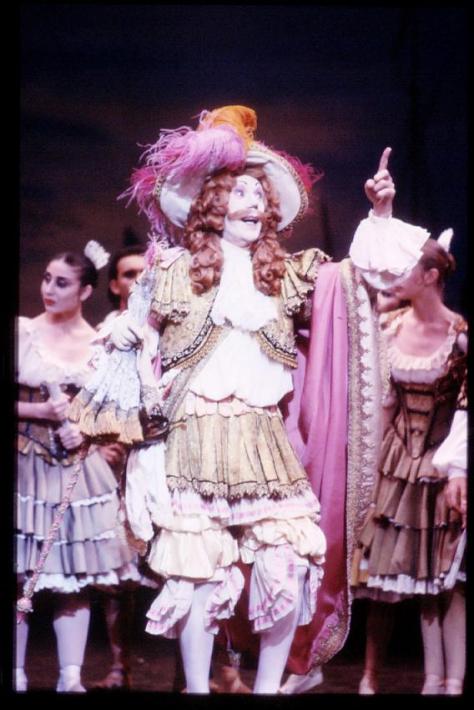
Colin Peasley as Gamache in Rudolf Nureyev's Don Quixote, 1993. (Photo: Jim McFarlane, courtesy of The Australian Ballet)

How did you find Nureyev, the choreographer, to work with?

The man knew more about dance than anybody I’ve ever met. He was able to create female and male roles, and dance female roles incidentally better than most of the females. He was able to show them what was important in the step and how to bring this out. This was a clever quality.

I can’t imagine how any of our principals ever could achieve this, and this is not being rude to our principals mainly because when you’re on stage for your pas de deux and you come off, you go backstage to change or to rest. But he must have stayed in the wings all of those times in Russia, because how did he come out here and reproduce all those bloody ballets with 500 different people doing things all over the place – corps de ballet people that he probably didn’t give a stuff about but he knew all their steps, knew how it all went together. This is amazing. Kelvin Coe was another one. Kelvin Coe could dance everybody’s role in every ballet.

What is your most vivid, publicly admissible memory of Nureyev?

The stories are always good stories but they’re not what I remember him for. I remember him for being a superb artist on stage, for the times with Fonteyn doing performances that had the audience standing and cheering for longer than anybody’s ever had since. In Sydney, when he first came out, he did Corsaire in the old Elizabethan Theatre in Newtown and the 12-13 minute pas de deux would get 15 minutes of curtain calls. I’ve seen him come back and do the whole coda again. When was the last time you saw that?

Never.

This is a period we’re never going to see again. They’d say to him, “Are we going to do the coda again?” and he would say, “They’re not breaking chairs!” meaning they hadn’t stood up and jumped and yelled long enough. To be a part of that, to see the magic of these people – and you’ve got to remember we toured Europe with them as their backing group for three months, as well as the other times; for us this was a crash course in how to develop into an artist. It taught us all the good things.

At the same time we had people like Helpmann. During the filming of Don Q I would complain about having to come on to the set at six in the morning for make-up because I was too young-looking, I’ll repeat that “too young-looking”, and they had decided to spray me with latex, which wrinkles when it dries. Then on top of the wrinkled face they’d put this white make-up so that on camera you couldn’t see the latex and by the time I took it off at night, my face was like a prune. But it did make me feel old. So while I was bitching about that, Helpmann said, “What you’ve got to remember, Colin, is that we’re the ones getting the close-ups. Everytime they take Nureyev and Lucette, they’ve got to take their whole bodies and they’re way back. Who do you think they’re going to remember at the end of the film?”

Nureyev always got the publicity in the press. Once the dazzle of his initial appearance had been pushed into the background, he got the publicity for being a bastard: for slapping the ballerina, for throwing a tantrum, for making demands. But, if you say that all publicity is good publicity, could dance use a few more Nureyevs?

I think dance needs another Nureyev. I don’t think it’s going to get one for a while. And I say that because both Nureyev and Baryshnikov came out when there weren’t such good male dancers around so it was really easy to see the difference between Nureyev and everybody else even though, for instance, Garth Welch could dance almost as well but didn’t have the charisma and didn’t have all that publicity backing, which is part of this machine that makes you into a star.

Nureyev was treated like a rock star and acted like a rock star – all that thing of drugs and going to the clubs and the stories about him out at three o’clock in the morning with six or seven people on his arm. It was grist for the mill. Being over-the-top helped greatly but he couldn’t have been a star if he hadn’t been able to come up with the goods in dance. And very few people have the ability to walk on the stage and to attract your attention like that.

He’d walk on stage and some poor woman over here could be doing 32 fouettés and all eyes would instantly go to this man who just walked! Oh, come on! That’s wonderful, that’s charisma. That’s the star quality and today, even in film it’s gone. Where are those stars, the Bette Davises? It was a different time and in dance it was able to be done because the general standard of dancing wasn’t as high. For somebody to come out of The Australian Ballet and make you all go, “Wow!” is very difficult because all those principals are “Wows!” And there’s even a few corps de ballet that are “Wow!”

Yes, but I think there’s a difference in certain individuals. For example, you look at film of Baryshnikov doing something like the Albrecht solo from Giselle, in Dancers, which he does three times in succession in front of a mirrior and each version is identical and he’s consciously striving after that. There are not many dancers who have that level of control. So, you’re talking about unique genius and that flowers only rarely. Nureyev was quite the opposite, he would do it three times and do it completely differently and wow you again because of the variety…

Nureyev was amazing because he pushed the boundaries. He would hold the curtain between acts, while he went over and over things. He danced on second breath. I don’t know anybody other than Eric Bruhn, who did the same thing. By that I mean that most dancers will hold themselves back in class so they’d be fresh for the evening performance. But Nureyev would do a solo maybe six, seven times with the conductor on stage and things weren’t working. You’d think, oh God, what’s going to happen when the curtain goes up because no-one knew if it would work. It was like a circus with the excitement. Eric Bruhn would do the same thing but if it wasn’t working, he’d change it. So, if his double saut de basque around the room weren’t working, they’d become double assemblés! Or he’d change it so that when he went on stage, he was absolutely sure everything was going to work perfectly.

There are the camps of people who feel that Baryshnikov is superior or that Nureyev is superior, or, I know people who swear by Eric Bruhn as the ultimate dancer. Would you single out Nureyev?

Actually, Eric Bruhn’s the one that appeals to me because of his pure classicism and there was never anything that he did which didn’t look like it should have been photographed and put into a book on technique. Nureyev was interesting because of his personality and because he took huge risks. And Baryshnikov because he’s got this wonderful, easy jump and turning ability but, unfortunately, I didn’t think Baryshnikov had the intelligence of Nureyev. For instance, I think Baryshnikov does things in Giselle that no prince, real or imaginary, would do. I don’t think he has the integrity that Nureyev had but he’s still an amazing dancer, by God, I’m not taking anything away from him.

While there is no doubt that an interpretive artist evolves and improves over time, your Gamache has not altered radically over the years (comparing the 1972 film of Don Q with the most recent revival performance in 1999). Why is that?

When you do some roles, you’re not comfortable with them. There’s something that doesn’t click, you really haven’t discovered the person. So, you want to fiddle with it and experiment. With Gamache, firstly I was coached very well by Nureyev and I felt that the person who came out of that coaching is exactly the way Gamache should be. And, in spite of the fact that I’ve seen other people do it, I always felt our version was better. I think my character was more three dimensional, more rational that he was the sort of person who would have done those things, that he wasn’t camp, he wasn’t a figure of fun in himself, he was a figure of fun because he stood out against all the other people. He was an outcaste in that group. So, because I thought my interpretation was a good one, I’ve maintained it.

So the character becomes a personage, like Dame Edna Everage is a personage so that whatever the character does is automatically “ in character”?

I find the best character creation is the one that you’re not acting but the one you’ve taken and put on. So, when you go on stage, I could have had a really bad day rehearsing people or a really good day and part of that personality is reflected in the person you see on stage. I don’t try to divorce the way I’m feeling from the person, so he changes slightly in that way but the person himself is Gamache. It is a person, I know him, I could show you exactly who Gamache is right now.

When you play parts like Friar Laurence and Cardinal Richelieu (The Three Musketeers), both clerics but at the opposite ends of the moral spectrum, what in each instance do you focus on?

The first one, because of Shakespeare’s Romeo and Juliet, has a hell of a lot of things written about him but he is a peasant priest. He is not an educated priest. He makes dreadful decisions in what he does for Romeo and Juliet. I mean why did he marry them? Why did he let that happen when he knew it was going to cause all that trouble. Why did he make the vial of sleeping potion? These are dreadful things. Compare this with Richelieu, who is noble by birth and not only a cardinal but First Minister of the state, he was Louis XIII’s Prime Minister and he was a very powerful, very intelligent man but absolutely ruthless to the point of evil – destroying the Huguenots, basically starting the 30 Years War, making it so that Louis XIV can become the first absolute monarch. Richelieu is pushing towards that, doing dreadful things to those nobles, with spies everywhere!

They’re two wonderful characters. The first one because he’s a bit ditsy and the second because he’s got so much power.

Your Friar Laurence has a kind of naivety that is very absolving. Like you, I’ve wondered about why he does the things he does but he has a kind of innocence that drives him…

Exactly. Because he’s illiterate and because he’s a man of faith, and faith is very strong in him, he believes that God will handle all these problems. God will be on the side of right but God isn’t always on the side of right, unfortunately. Because these people should be together, doesn’t mean they will be and that’s where a lot of these religious people fall down. It’s not a rationally explicable God up there.

Your interpretation of Madge the Witch in La Sylphide is very subtle. How do you see this character and how did you arrive at your interpretation? I ask especially because you’ve already talked about Eric Bruhn, who was also such a famous Madge himself.

He actually did it here. It was the last performance before he died, which was a few months later.

Sylphide wasn’t taught to us by Eric. It was taught to us by Constantin Patsalas, who was a choreographer and a close friend of Eric. Madge was taught first on Paul De Masson, I think.

As the role of Madge developed over time, it turned into a caricature ( as Colin says this, he raises his hands like twitching claws, tilts his head to the side and distorts his face with a maniacal scary cackle ) and I can’t see how this could have happened in Denmark because they’re so famous for their actors and I can’t see how it could have happened when some who played Madge were women. I can’t see a woman doing this send up. So, when Eric started demonstrating things, my whole concept changed because I was angling towards that way anyway. When I saw Eric do it – he only did it on the Saturday night (premier season, 1984) – there was more power, more validity in this person being a pathetic old woman who has secret powers that she can use but she doesn’t go round throwing it out. She only does it when you tread on her. She is a mirror; if you’re nice to her, she’s nice to you and that’s why she says to those girls, “Oh, you’ll be married, you’ll be happy!” and all this. Then, when other people start to do things, she says, “No, you won’t marry her but you will…” The only thing that doesn’t really work there is in the witch scene when they are all going, “Agrh, agrh…” (Colin mimics the dancing demons), which seems a mocking of the whole thing. I’ve never been able to relate how I can do that less while everyone around you is doing all that grotesque dancing. Otherwise, I think the way I’m doing it works.
What is your favourite role?

I think my favourite role is the Baron in The Merry Widow ( This role was created on Colin in 1975). I love the Baron; I think he’s such a nice person. I love the way he won’t believe he’s being cuckolded, even though everybody is saying, “She’s doing things behind your back.” And he doesn’t believe it right up to the last act when he actually sees it happen. He is really brokenhearted but then when he goes out he says, “Come on, you’re young and he is young and I understand…” That’s really nice, I like him.

Do you have a favourite ballet?

No. And it’s because ballets are so varied and your moods are varied. I’ve seen this (current) performance of Mr B four times. I’ve always loved Serenade and if I was a female dancer, this is a work I would really love to do. Then, last night when I saw the show, I thought, no, Symphony in C would be the best one to do – it’s brash, it’s out there. If you feel romantic or soft, Serenade would be the one, or you feel dominant, like I normally feel, then Symphony in C. It depends on how you feel. But I love Giselle, which is a master work; Les Sylphides, which we don’t do anymore – please God, let it come back Raymonda, which has a stupid story but the most beautiful dancing. And I don’t want someone else to do it; I don’t want them to ask a contemporary choreographer to put on a new production. I want the Nureyev steps, based on the Petipa because it’s the dancing that I loved.

Would it be possible to restage it?

Well, yes. We have the notation, even though Nureyev is dead.

As a performer, do you stew before or after performances, if ever?

I do both and I still get very nervous before a performance and the dancers in the company find that amazing. A dancer gets nervous because they realize they might fall over in their pirouette or their jump may not be as clean as they want it; they think because you’re doing an acting role, there’s nothing to get nervous about.

Acting roles always have a lot of props. You’re always handling a lot of things and, quite honestly, if you muck something up, then you’ve made the story ridiculous. So, I still get nervous and while I don’t stew, sometimes at the end of performances, I think, “Oh that should have been done and why did she look at me at that stage, the timing of that is really out…” Acting on stage isn’t really acting, it’s reacting and if the person you rely upon to do something – so that you can react to that something – mistimes, or does it wrongly, it makes your reaction stupid.

Again, this is something not all artistic directors realize. We had one director who would take one of the principals into a room and rehearse the entire Giselle mime scenes just with this girl, without an Albrecht, without Hilarion or anybody else around. So, when the dancer went into a full call, she would be curtseying on the count two and a half, and be running away laughing on the count of three, no matter what Albrecht did. A nonsense! The curtesy has nothing to do with the count of two and a half; the curtsey has to do with “Thank you, sir,” for whatever he’s done.

As an artist, what is your principal inspiration?

My principal inspiration, in the beginning, as a dancer, was Eric Bruhn and Nureyev. To me, they were the epitome of what classical dancing was all about. I was also lucky in The Australian Ballet because we had Ray Powell and Sir Robert Helpmann – and Algeranoff at one stage, too – all great character actors who could do amazing things on stage. The classical standard was set by the fact that we performed with Bruhn and Nureyev for two or three years and the value of our character work was set because we had these great artists with us. It’s wonderful to have the luck to do that and it’s a while since any of our dancers have had the luck to be around great character dancers and to see this sort of thing happening.

I’ve never believed that character work isn’t of value. I believe that if you’re telling a story ballet, then the most important thing is the story, not the dancing even though we use the dancing to tell the story. Because of this I’ve always been very comfortable in what I do.

Inspiration for roles comes from a variety of places. And these days you can get video of any bloody film in the entire world. The other day I went into a place which had more DVDs than I’ve seen in my life! There’s no reason why we can’t look up any actor; in my day, we had to remember them. We had to remember ballets. We hardly ever saw a dance company out here and if we did, that had to remain in your memory and, of course, memory enhances and makes you believe that they were doing it better than they were. Now we can just pick up a video and it’s so much easier.

In Graeme Murphy’s Nutcracker (created in 1992) you play one of the Russian émigré friends of the elderly Clara. Tell me about the process of that creation.

Well, it wasn’t only Graeme but Kristian Fredrikson, who designed it, who was also very active in the way the ballet was put together. In the first rehearsals, we also had all of those wonderful Borovansky dancers and other dancers from the early age, around us – Maggie Scott, Valrene Tweedie, Athol Willoughby, Harry Haythorne. In the ballet, the old dancers are part of the Russian émigré community, which was only small. So, every Christmas they would go to Clara’s place, bringing their little gifts and this year they knew that it would be her last Christmas because she was starting to fade. They’re all worried about her because she’s living alone, with her memories. And my goodness, when you reach my age, you understand those things. I’ve visited people and thought that might be the last time I visit them.

The range of those characters plus the fact that we (the cast) were so different in our own personalities and lifestyles, meant that we all came out so distinctly different: the part that Harry played, that Paul de Masson played, I think even Stephen Baynes was in the first one. We had all these different old men and you could see them as that. They’ve got the camaraderie of being expatriots and having a common interest in Clara. I found it very easy to start that character.

Graeme allowed us to have some input and that always makes tha character better because it fits you better. If you’ve got to walk into someone else’s shoes it takes you a while to work out what those shoes are like and how that person walked in those shoes. I pity anybody who’s trying to get into my roles because they are so personal, so based on my body and my way of moving.

When you did the group dance at the party in Nutcracker, how much instruction did you get from Graeme on how to do it?

A lot. Graeme was very determined about how it should happen, what the steps were and he kept encouraging us to do more. He was like a cook: he’d put in the ingredients but then as the ingredients either came up or down, he added a bit more salt or flour or whatever. It wasn’t ad libbed.

Did he make you go harder or slower?

He did. He would say to people, “I think this doesn’t work, I think this should happen.” I think that’s the way most theatre producers work these days. They do a reading of a play, then work out what these characters should be doing and whether it’s coming across and whether it’s readable to an audience. Graeme was the person doing that. But he had all the gimmicks of bringing out the photos, which makes the scene work so well. And the fact when she (Clara) was going to have a heartattack and the bit where she has too much vodka and dances, thinking she can do more than she actually can; and the lovely bit with the doctor coming in with the film.

How strenuous did you find it?

Not at all. Graeme has the greatest flow of ideas of anyone I’ve ever worked with. The man is so amazing, so amazing that I’ll give you a small anecdote. When I was Ballet Master here and he was doing an early ballet, he spent time on a lift with a girl that wasn’t working. He could get her up there and do things but it was not coming out the way he wanted and they weren’t getting it. He tried for about two days then the next day he said, “That’s not working, Colin.” And he not only cut that but about 32 bars going into it because that was part of the build-up and he started from scratch. I thought, why would you do that, I loved all that! But then two or three years later, it appears in another ballet. It’s mulled around, and he’s worked out how to get in and out of that lift so that it looks effective and it’s gone in somewhere else. I love this man, I mean, this is really great stuff. And it’s sensible, why waste all that time?

You are the only foundation member of The Australian Ballet who still performs with the company on a regular basis. What does the foreseeable future hold in this area?

Death! I think I’m very lucky at the moment in two ways: the company still uses me, and I think they like me, and there are not too many of my era who are willing to get up and make an idiot of themselves. I hope that as I go into my nth year, they’ll still continue to use me.

Many interpreters of character roles tend to have a speciality that distinguishes their approach, for example: the late Ray Powell was, at his best, a benevolent bumbler; The Royal Ballet’s Derek Rencher always maintains a dignified distance; Ken Whitmore camped it up. You completely defy categorization, which in ballet terms, at least, puts you in league with the likes of, say, a Geoffrey Rush, on screen. His output, for example, includes the comical entrepneur in Shakespeare in Love and the evil political figure in Elizabeth, to name two roles from the same historical period and about the same time in his acting career. How have you managed such variety?

Going back to movies, which you just brought up, the one type of actor I don’t like is the John Wayne. John Wayne was John Wayne in every movie he did. Why people said he was good, I have no idea. I don’t think that’s acting. I think acting is when you get somebody like Geoffrey Rush who tries to delve into the character and brings out what that character should be. And I think that’s fun, don’t you?

Yes, but to be able to do it?

Well, the one thing I don’t want to be on stage is Colin Peasley. I’ve never been tempted to be myself; I don’t like myself so much that I want to replicate myself all over the place. An important part of theatre is the preparation time: when you’re in your dressingroom. Martha Graham phrased it beautifully: as she was putting all this hot black on her eyelashes, she said, “When you look in the mirror, you don’t look back at yourself but Cytemnestra does!”and with that, she upped and out the door. That’s exactly what it’s all about. Going into the dressingroom and putting on rock music while you’re slapping on a little bit of face, isn’t preparing for a role at all. Preparing for a role is thinking about it and getting your face to look like you think that person should look. Then when you put on the costume you are that character, not in the Nijinsky way – they say he used to be in character for an hour after the performance, which I think is a bit overdone but I understand what he was doing. Look at those photos of Nijinsky – in every photo he looks different.

You just said you don’t want to be Colin Peasley. Tell us a little bit about Colin Peasley. I know you’re fussy about ironing, so you’re big on costume, even in everyday life; you like it just right…

I think Colin Peasley’s biggest regret in life is that he didn’t discover dance earlier. Although I was a ballroom dancer from the age of 16, I didn’t start doing classical dance until I was about 21. That was obviously too late to be a dancer, even in my day. I’ve had this huge love of dance ever since but not the capacity to fulfil it. That’s a regret in my life.

The joy in my life, is that when you come to a thing late in life, the love continues longer but also you come to it with more knowledge, more understanding of what you’re doing. It’s not monkey see, monkey do like it is with a five or six year-old kid, so, I think I’ve approached dance more intellectually, which is probably the wrong way to approach it. But, it’s meant that I’ve had a huge joy in teaching and I love teaching. It’s not just saying, “Point your foot here!” it’s trying to work out why you point your foot here. That’s a part of learning, asking more questions than you know the answers to. Colin Peasley loves all that.

And, he loves to be on stage. They could ask me to walk on as a butler and I’d say, “Yes, please!” I don’t have to be a star, I just like being there.

And why?

Because it’s a drug. The excitement of being on stage, the buzz of people around you, the old thing about the smell of grease paint and the roar of the crowd is all there. And at the end of a performance when they’re all yelling and screaming, even if you’re in the back row, you imagine it’s for you. Nobody stood in the back row thinking it’s all for Fonteyn and Nureyev but for them, because they did such a lovely peasant – and I do, too.

In recent years you’ve become very adept at handling computers and technology, partly in your work as Education Program Manager. You’re not just a performer, there’s a lot more to your life…

Yes and this is partly to do with my upbringing and the way my family approached education. They thought it was very important and I do, too. They allowed me to question and I’m a questioner, I want to know how things work. That’s the reason why I cook and I enjoy cooking. I’m a voracious reader, I’m a collector of books; I have more books in my house than I have house to put them in.

What sort?

I’m a very catholic reader, when I’m on planes I read detective stories, which can be the biggest load of trash and it’s relaxing not to have to think. But then, I would say I’ve got the largest collection of ballet books in Australia outside the Australian Ballet School. I’ve been collecting since I discovered ballet. All this has kept me with what I think is most important for life and that is an interest. I’ve got an interest and my basic interest is dance but now there is a lot of other things, too.

Tell me a little bit more about your family background?

I grew up in Sydney, I have a sister who is seven years younger than me, which meant that we were both treated as only children, which was a disaster. I’m not close to any of my relations. I went to Sydney Technical High School. At that stage, I imagined I wanted to be an architect. I studied German at school and that’s strange because this is just after the war (WWII) and they were still teaching it. I got my qualification certificate to go into university and I never went. We didn’t have the money and I couldn’t afford to do things like that so I worked in a shop during the day and I did some night school courses. Then ballroom came into my life, I rushed off to ballroom classes and became a teacher of ballroom.

When I was at Bodenwieser’s and doing ballroom, I had a very good friend, Alan, an Asian, who said to me that he wanted to do acrobatic dancing and I said I’d always wanted to do tap. We’d taken our girlfriends to the Tivoli for one Saturday evening – when you’re doing ballroom, your partners are always your girlfriends because you don’t want to loose them – it’s the truth! Even if you’re not really compatible, they’re your girlfriend. On the back of the program was an ad for the Tivoli acrobatic and tap school; it was like God talking to us. So we went to Tibor Rudas and Sugar Baba. And we tapped and acrobatted ourselves away there, while I was still doing ballroom and modern dance and working during the day. Across the way, we saw a jazz class that was absolutely wonderful. I said to Alan, we’ve got to join that class, thinking of Fred Astaire and all those people. The woman there said you’ve got to do one classical class to do one jazz class. I said, “No, thank you,” went back up and did shuffle, step, shuffle, step and kept looking. Eventually I went back, talking for both of us, “We will do it, on the understanding it’s a private lesson and we don’t have to wear tights.” So, we did our first classical ballet lesson – I was 21 – in shorts at ten o’clock at night with Valrene Tweedie. That’s how it all started.

What did your forebears do, what were some of their occupations?

My father was a printer and my mother was a housewife. My grandfather on my father’s side was a baker. I don’t know what my grandfather on my mother’s side did, but that’s where the German side of me comes in, their name was Waghorn.

I’m still intrigued by your ability with computers because it tends to be a generational thing. Everyone under 20 lives on the internet and computers are an integral part of their lives but many middle aged people and even some younger ones, whom I know, are completely lost with that technology, yet you’ve taken to it so easily…

I think this is part of my nature. I’ve got this dreadful streak that I must be self-sufficient. For instance, I must be able to sew up trousers on a machine, I must know how to bake a cake, wash a floor and do all those things. I live by myself, so I’m entirely self-sufficient. And if I’m going to work with one of these things (he indicates his computer), I want to know exactly how it works and how much I can do with it. That’s why I play the piano. I thought, if I’m going to be a dancer, and you read that all these great choreographers and dancers are always musicians, I thought I’ve got to learn music, too.

Do you still play, do you practise?

I play but I don’t practise. And I only play pop; I don’t play classical any more.

When you say “pop”, what do you mean?

I mean (bursting into song) “Daisy, daisy, give me your answer do.”

On that cheerful note, I think we will wrap it up. Thank you Colin.

My pleasure.

Blazenka Brysha

Futher information about Colin Peasley may be accessed via the National Library of Australia web site www.australiadancing.org